Almost every "side hustles for bilinguals" article gives Spanish speakers the same three answers: tutor, translate, or answer customer-service tickets. Those still work. But the highest-demand buyer of Spanish-language hours in 2026 is one none of those articles mention: the AI industry. Every major language model needs native-quality Spanish feedback, and with 636 million Spanish speakers on Earth, the labs cannot get enough of it. Platforms are running Spanish-specific tracks for prompt writing, response evaluation, translation review, and voice work, and bilingual contributors routinely qualify for projects monolingual workers never see.
This guide covers the ten platforms with the most consistent Spanish-language work, what each actually pays, the dialect detail that decides which projects you match (es-MX is not es-ES, and platforms know it), and how the classic hustles compare. Everything links to a deeper review or a company profile we maintain.
How we researched this guide
We hold paid accounts on eight of the platforms below (including DataAnnotation, Outlier, Mindrift, OneForma, and CrowdGen) and track their language-track availability directly; the Spanish-project details come from those dashboards and each platform's own listings, not from other blogs. Market statistics are cited from the Instituto Cervantes, Preply's bilingual-pay research, and ZipRecruiter salary data, all linked in Sources. To be transparent: we are not Spanish speakers ourselves, so pay figures are platform-published and community-verified rates rather than our own Spanish-track earnings.
The Spanish advantage, in numbers
Spanish speakers worldwide
636 million
Bilingual pay premium
5–20% per hour
Avg US online-Spanish role
$33.65/hr
Platforms with Spanish tracks
10 below
Why Spanish specifically pays in 2026
Three forces stack in your favor. First, scale: the Instituto Cervantes puts Spanish at 636 million total speakers, roughly 519 million of them native, the second-largest native language on the planet. Any product, model, or dataset that wants global reach needs Spanish early, usually first after English.
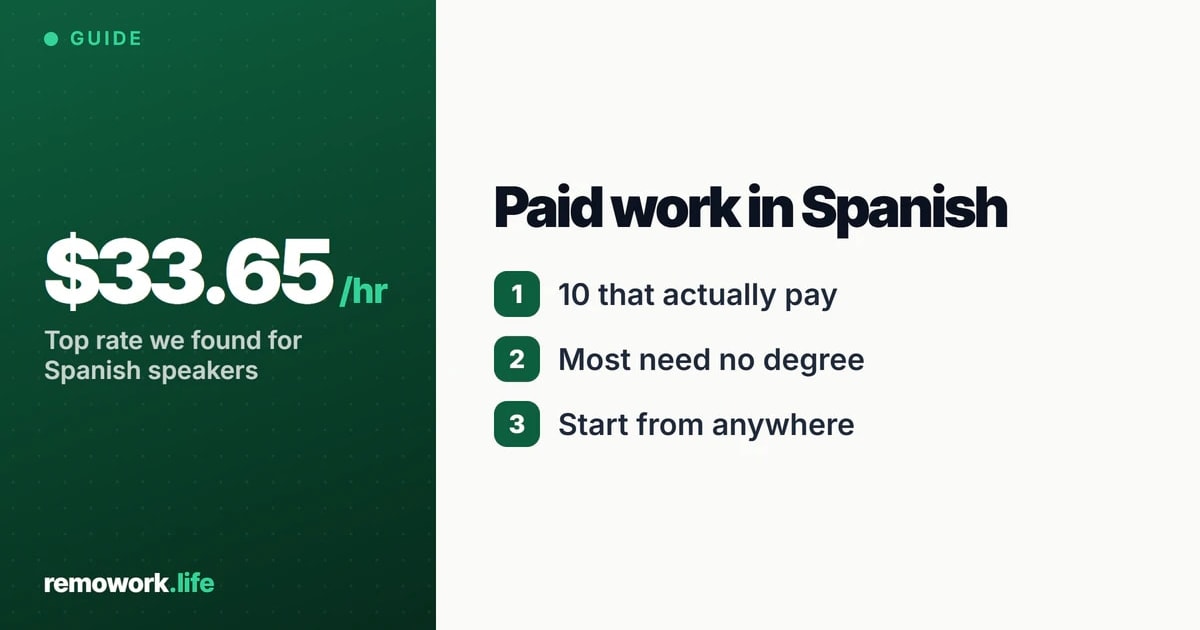
Second, a measurable wage premium. Research collected by Preply found multilingual workers earning on average 19% more than monolingual peers, and across US employers the commonly reported bilingual differential runs 5% to 20% per hour. Job-market data agrees: Spanish sits alongside Mandarin and French as the most in-demand languages for part-time roles, and ZipRecruiter's July 2026 data puts the average US online-Spanish position at $33.65 per hour.
Third, and this is the 2026-specific part, AI labs discovered that machine-translated training data produces stilted Spanish, so they now pay humans to write, rank, and correct model output natively. That work is remote, task-based, and gated by fluency instead of degrees, which makes it a genuine side hustle rather than a career change. It is also the tier the classic "tutor or translate" articles have not caught up to.
The dialect detail that decides your matches: platforms do not hire "Spanish", they hire locales. A Mexican-Spanish (es-MX) evaluation batch will not match a profile that only says "Spanish". When you register anywhere below, state your variant and every variant you write comfortably. Heritage speakers who grew up bilingual qualify for most evaluation work; formal certification is rarely required outside professional translation.
Know your locale codes (list the ones you can write natively)
es-419 ("neutral Latin American") is the most requested variant in AI and localization work; es-US is surging with US product demand. If you can write clean es-419, say so explicitly.
Tier 1: AI training platforms with Spanish tracks
The best pay-to-flexibility ratio for bilingual side income right now. All are free to join, remote, and assessment-gated.
DataAnnotation
DataAnnotation runs dedicated multilingual batches, and Spanish is a recurring one: chatbot evaluation, response ranking, and translation checking in the $20–$30/hr band, with general English-side work at $25–$30 and coding tracks at $50–$75 if you have that skill too. Bilingual contributors effectively double their eligible task pool, which matters on a platform where work arrives in waves.
Spanish tasks
Eval, ranking, translation QA
Pay band
$20–$30/hr
Paid via
PayPal
Entry
Written assessment
Key detail: the starter assessment is in English; declare Spanish on your profile so language batches can find you. PayPal-only payouts, so confirm PayPal receives in your country first (see our payments guide). Full platform breakdown in our DataAnnotation review.
Outlier
Outlier (Scale AI's contributor arm) runs explicit language-specialist tracks, and Spanish projects appear continuously across es-MX, es-ES, and es-419: rating model conversations, rewriting awkward output into natural Spanish, and bilingual comparison tasks. Multilingual work generally sits in the $15–$30/hr range with specialist bumps above it, and language taskers are exactly the profile Outlier recruits hardest.
Spanish tasks
Conversation rating, rewriting
Pay band
$15–$30/hr
Paid via
PayPal, AirTM, ACH
Entry
Onboarding tasks
Key detail: task volume swings by domain week to week, which is why Spanish plus English eligibility is a real hedge: two queues instead of one. How the waves behave, and what to do in quiet weeks, is in our no-tasks guide and the Outlier review.
Mindrift
Mindrift (Toloka's specialist arm) runs projects in 20+ languages, and Spanish is a fixture: AI conversation writing, response evaluation, and domain tasks that pair language with a subject like finance or law. Pay runs $15–$100+/hr depending on how specialized the pairing gets; a Spanish speaker with any professional domain climbs that ladder fast.
Spanish tasks
Writing, eval, domain + language
Pay band
$15–$100+/hr
Paid via
Payoneer
Entry
Adaptive domain test
Key detail: the signup test adapts to the specialty you pick, so choose the language track deliberately. Our Mindrift review covers the test format.
TELUS Digital
TELUS Digital's AI Community is one of the longest-running buyers of Spanish-language hours: search-relevance rating for Spanish-speaking markets, speech recording, and data collection projects that specifically want in-country es-MX, es-ES, or es-US raters. Rates are program-dependent (roughly $7–$25/hr by country and role) and projects run long, which makes it good baseline income under spikier AI platforms. See our first-hand TELUS International AI review for real pay and how to apply.
Spanish tasks
Search rating, speech, collection
Pay band
$7–$25/hr by country
Paid via
Hyperwallet / bank
Entry
Program exam
Key detail: many TELUS programs require residence in the market they rate, which is an advantage if you live in Mexico, Spain, Colombia, or the US: locals face less global competition for those seats.
5. OneForma
Wave-basedCentific's crowd platform rotates hundreds of projects, with Spanish appearing across transcription, speech collection, translation QA, and its Brazil-and-beyond data programs (its egocentric Project Triangle explicitly recruits by language). One registration covers everything; respond fast when a Spanish batch opens. We have completed OneForma projects first-hand and been paid.
6. CrowdGen (Appen)
Wave-basedAppen's contributor platform has recruited Spanish speakers for search evaluation, voice recording, and annotation for over a decade, typically scoped "participate from anywhere within [country]." Entry-level friendly, no degree needed, and its long-running search-rating programs favor steady part-timers. We have worked CrowdGen projects ourselves; see also the Appen profile.
Tier 2: localization and translation platforms
The traditional home of bilingual work, still strong, and increasingly blended with AI (post-editing machine translation now outnumbers from-scratch translation). Better suited to strong writers than casual speakers.
7. Lionbridge
A localization veteran whose AI-data arm runs continuous multilingual programs: search and ads evaluation, speech recording, and translation review. Spanish is among its most requested languages, and its rater programs are a classic first bilingual side hustle.
8. Welocalize
Runs multilingual search evaluation, ads assessment, and AI data programs with named language requirements; es-ES and es-419 roles appear regularly on its jobs board. Native-level fluency is usually specified, and rater roles are part-time by design. Its AI-data arm hires through Welo Works, see our first-hand Welo Data review.
9. RWS
One of the largest language-services companies in the world, hiring freelance linguists for translation, post-editing, terminology, and AI training data. The bar is higher (professional translation experience helps) and so is the ceiling; serious ES↔EN translators should have a profile here.
10. Lilt
An AI-first translation company where linguists work inside its adaptive MT tool, reviewing and improving machine output. The human-plus-AI workflow is exactly where translation income is heading, and Spanish pairs are core volume. Experienced translators can build ongoing engagements here.
What bilingual Spanish work actually pays
| Task type | Typical range | Where |
|---|---|---|
| AI response evaluation (Spanish) | $15–$30/hr | DataAnnotation, Outlier, Mindrift |
| Bilingual prompt writing / rewriting | $18–$35/hr | Outlier, Mindrift, DataAnnotation |
| Search & ads rating (Spanish markets) | $7–$25/hr | TELUS, Lionbridge, Welocalize, CrowdGen |
| Speech recording & transcription | $10–$25/hr equivalent | OneForma, CrowdGen, TELUS |
| Translation review / MT post-editing | $20–$35/hr | Lilt, RWS, Welocalize |
| Domain expert + Spanish (law, finance, medicine) | $30–$100+/hr | Mindrift, expert networks |
Two honest notes on those numbers. Rates vary by country as well as task; search-rating programs in particular pay local-market rates. And everything above is wave-based: bilingual eligibility widens your task pool but does not exempt you from quiet weeks, which is why the same stacking strategy from our $0 to $1,000/month roadmap applies: run two or three of these platforms in parallel.
The classic hustles, and when they beat AI work
AI training is the newest and most flexible Spanish side hustle, but it is not the only one. Here are the established options, what they pay, and when each beats task-based AI work.
Spanish transcription and subtitling
Rev, TranscribeMe, and similar platforms pay roughly $10–$30/hr to transcribe or caption Spanish audio and video, with bilingual captioning (Spanish to English and back) at the higher end. It suits fast, accurate typists who want piece-rate work and no scheduled shifts. One honest catch: AI has pushed raw transcription rates down, so the better money now is in reviewing and correcting machine output, which is close to AI-training work anyway.
Spanish localization and translation
Localization vendors like Welocalize and RWS hire Spanish linguists for translation, review, and language-quality work, and document translation or interpreting pays best of all once you hold certification. Language-exam scoring sits around $12–$30/hr. This tier rewards credentials: without them, the Tier 1 AI platforms above usually pay more for far less gatekeeping.
Bilingual customer support and virtual assistant work
Bilingual Spanish customer service is the steadiest option: US online-Spanish support roles average $33.65/hr per ZipRecruiter, and bilingual virtual assistants run about $18–$35/hr. The trade-off is that these are scheduled jobs, not flexible side hustles, you work set hours. Choose this when you want reliable weekly income over start-anytime freedom.
Spanish voice-over and voice acting
With a clear voice and a decent microphone, Spanish voice-over pays per project or per finished audio hour, and demand is climbing because AI models need native Spanish speech. Voice-data platforms pay you to record scripted and natural Spanish audio; see our Pila8 review for one that specializes in audio and video data. Rare accents and clean neutral es-419 delivery command a premium.
Online Spanish tutoring
Tutoring on Preply or italki suits natural teachers and pays on reputation, typically $15–$30+/hr once you build reviews. It is the slowest to ramp (you need students) but the most durable: your rate rises as your profile does. It works best as a long-term anchor alongside a faster AI platform.
The AI tier at the top of this guide wins on one axis the classics cannot match: you can start this week, with no certificate, no students, and no shift schedule, and scale hours up or down at will.
Set up your profile to actually get matched
Declare the variant, not just the language
"Spanish (es-MX, comfortable with neutral es-419)" matches more batches than "Spanish." List every locale you genuinely write, and your English level alongside it: most bilingual tasks require reading instructions in English.
Take the language assessments seriously
Bilingual tests check writing quality in BOTH languages: accents, punctuation (¿ ¡), and register. Rushed answers cost you the exact tracks that pay the premium. Our acceptance guide covers the formats.
Stack a fast platform with a steady one
Pair one AI platform (DataAnnotation or Outlier for volume) with one long-cycle program (TELUS or Lionbridge rating) so wave troughs never zero your month. Then verify your payment rail reaches your country before you earn, not after: the full map is in our payments guide.
Frequently asked questions
How much can Spanish speakers earn on AI training platforms?
Typical bilingual evaluation and writing tasks pay $15–$35 per hour, search-rating programs $7–$25 depending on country, and Spanish paired with a professional domain (law, medicine, finance) reaches $30–$100+ on specialist platforms. Part-timers running two platforms commonly target $300–$1,000 per month.
Do I need to be a native Spanish speaker?
For most AI evaluation work, native-level writing is what matters, not birthplace, and heritage speakers who grew up bilingual routinely qualify. Localization roles (Welocalize, RWS) more often specify native fluency in a particular variant. Every platform tests you anyway; let the assessment decide.
Do I need a translation certificate?
Not for AI training, transcription, speech, or rating work: fluency plus passing the platform's own test is the whole bar. Certification mainly matters for professional document translation and interpreting, where it raises both access and rates (RWS-tier work).
Which platform should a Spanish speaker join first?
Start with DataAnnotation or Outlier for the best flexibility-to-pay ratio, add TELUS or Lionbridge for steady baseline hours, and add Mindrift if you have any professional domain to pair with your Spanish. Apply to two or three in the same week rather than one.
Does which Spanish I speak matter (Mexico vs Spain vs neutral)?
Yes, more than most people expect. Projects target locales: es-MX, es-ES, es-US, es-AR, or neutral es-419. Your variant is not a limitation, it is targeting data: declare it, plus any neutral-Latin-American writing ability, and you will match more batches.
Can I do this from Latin America, or is it US-only?
Most of these platforms are global, and several actively prefer in-country contributors for market-specific work (TELUS rating programs, OneForma collection projects). The real constraint is the payment rail: check that your platform's payout method reaches your country before investing hours; our payments guide maps every rail by region.
What remote jobs can Spanish speakers do from home?
The best-paying options are AI training and data work (evaluation, writing, and annotation on DataAnnotation, Outlier, and Mindrift), plus Spanish transcription and subtitling, localization and translation, bilingual customer support and virtual assistant roles, Spanish voice-over, and online tutoring. AI training is the most flexible; customer support is the steadiest.
Do Spanish speakers get paid more for remote work?
Often, yes. Multilingual workers earn about 19% more than monolingual peers on average, and US employers commonly pay a 5-20% bilingual differential. In AI training specifically, platforms pay a premium for non-English data because machine-translated Spanish is not good enough to train on, so native Spanish writing is a paid skill, not just a nice-to-have.
Are there Spanish transcription jobs that pay well?
Yes. Rev, TranscribeMe, and similar platforms pay roughly $10–$30/hr for Spanish transcription and captioning, with bilingual (Spanish-English) work at the top of that range. Because AI has compressed raw transcription rates, the better-paid work is increasingly reviewing and correcting machine transcripts, which overlaps with the AI-training tasks covered above.
Sources & how to verify this
- Platform data (first-hand): language-track availability and task types observed on our own accounts (DataAnnotation, Outlier, Mindrift, OneForma, CrowdGen, TELUS programs) and each platform's public listings; pay bands as verified in our individual platform reviews.
- Speaker population: the Instituto Cervantes' "Spanish: A Language to the World" 2025 report (636M total speakers, ~519M native).
- Wage premium and demand: Preply-based research on the ~19% multilingual premium, commonly reported US bilingual differentials of 5–20% per hour, and ZipRecruiter's online-Spanish salary data ($33.65/hr average, July 2026).
Language-track availability shifts with client demand, and rates differ by country. Last verified July 2026; we refresh this guide as platforms open and close Spanish programs.
The bottom line
Spanish is not just a skill in 2026, it is targeting data that half a dozen industries bid on, and AI training currently bids highest for flexible hours. Declare your variant everywhere, pass two assessments this week (one AI platform, one rating program), keep a third application pending, and route your payouts through a rail that reaches your country. The 636 million-speaker market is not shrinking, and neither is the demand side. Empieza hoy.
Find Bilingual Remote Jobs
RemoWork tracks AI training, localization, and language jobs across every platform in this guide, with pay and country eligibility on each listing.