$1,000 a month from AI training work is a real, reachable number. We know because we have crossed it: our documented earnings include a strong single month on RemoExperts and weekly Stripe payments from AfterQuery, with the screenshots published in our reviews. But almost everything written about "making money training AI" skips the part that matters: the route. Which platforms take beginners, what the pay ladder actually looks like, how long each stage takes, and where people quit one week before it starts working.
This is that route, in eight steps, with real numbers at every stage. It is the hub for everything we publish: each step links to the deeper guide or review that covers it, all of them built on accounts we hold and payments we have received.
How we researched this roadmap
Every number here traces to something we can show: paid accounts on AfterQuery, RemoExperts, Mindrift, DataAnnotation, CrowdGen, OneForma, SME Careers, and Handshake; documented RemoExperts payouts and $740 in documented AfterQuery payments; and the platform pay bands verified in our individual reviews, all linked from the steps below. Where a figure comes from a platform's own brief rather than our account, we say so. RemoWork also maintains the company directory and jobs board this roadmap links into, refreshed continuously.
The roadmap at a glance
Realistic timeline to $1,000/mo
3–6 months
Platforms to stack
3–4
Hours at $1,000/mo
6–25/week by skill
Startup cost
$0
Honesty before the steps: this is not passive income and it does not pay in week one. Work arrives in client waves, first payouts take 2 to 4 weeks, and quality gates are real. What the roadmap gives you is the shortest defensible path through all of that, and the receipts proving each stage is reachable.
Can you make money from AI training with no experience?
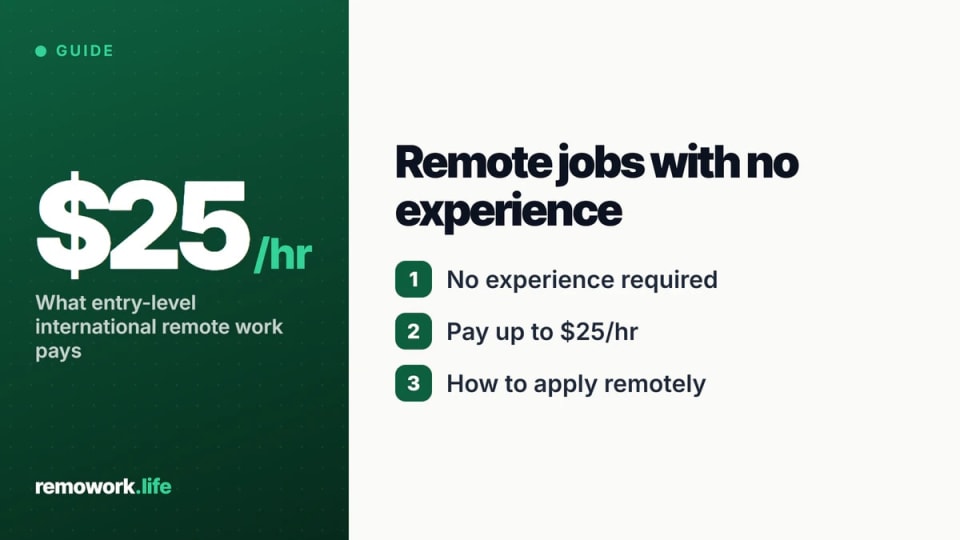
Yes. AI training is one of the few paid remote paths with a real no-experience on-ramp: generalist evaluation and data-collection work gate on a short assessment, not a degree or a portfolio. You start on entry-level tasks (roughly $3 to $30 an hour), build an approval record, and use that record to unlock the higher-paying specialist tiers. The rest of this guide is the exact path, from your first application to a steady $1,000 a month.
The pay ladder you are climbing
Every rate in this industry sits on one of four rungs. Knowing your current rung, and what buys the next one, is the whole game.
$3–9/hr
Rung 1: Collection & microtasks. No skill gate.
Recording chores (egocentric video), surveys, basic microtasks. Anyone with a phone qualifies.
$15–30/hr
Rung 2: General AI training. Assessment-gated.
Writing, evaluation, and annotation on Outlier, DataAnnotation, and RemoExperts (a hard $25/hr floor).
$25–75/hr
Rung 3: Skilled tracks. Coding, multilingual, domain writing.
Coding evaluation ($50–75 on DataAnnotation), specialist creative and technical tracks ($35–65 on RemoExperts), Micro1 evaluator roles.
$80–250/hr
Rung 4: Credentialed experts. Degree or license gated.
Medicine, law, finance, and research tracks on AfterQuery and the networks in our PhD guide.
$1,000 a month is: 25 hours a week on rung 1, about 12 to 15 hours a week on rung 2, 8 to 10 on rung 3, or 6 or fewer on rung 4. Every step below exists to move you up a rung or fill your hours on the rung you hold.
Step 1: Find your starting point (no experience needed)
Pick the track that matches what you already have. Applying "everywhere" wastes your first month on assessments you cannot yet pass.
Track A: No degree, no experience
You have a phone, English, and time. Start earning on rung 1 immediately while you prepare for rung 2 assessments.
Apply first: Atlas Capture or your region's recording project, plus DataAnnotation and Outlier for the step up. Full list in the beginner guide.
Track B: Skilled or bilingual
You write well, code, or speak a second language. Skip rung 1 entirely; your assessments open rungs 2 and 3 directly.
Apply first: RemoExperts ($25/hr floor), DataAnnotation (coding $50–75), Outlier, Mindrift (20+ languages), Micro1. Start with our Top 25 guide.
Track C: Degree, license, or deep expertise
MD, JD, PhD, ABD, or 5+ years in one specialty. Rung 4 networks actively recruit you; general platforms undersell your hour.
Apply first: AfterQuery ($40–250/hr tiers), then the expert networks ranked in our PhD platforms guide. Lead with your rarest credential.
Step 2: Set up your payment rails before you apply
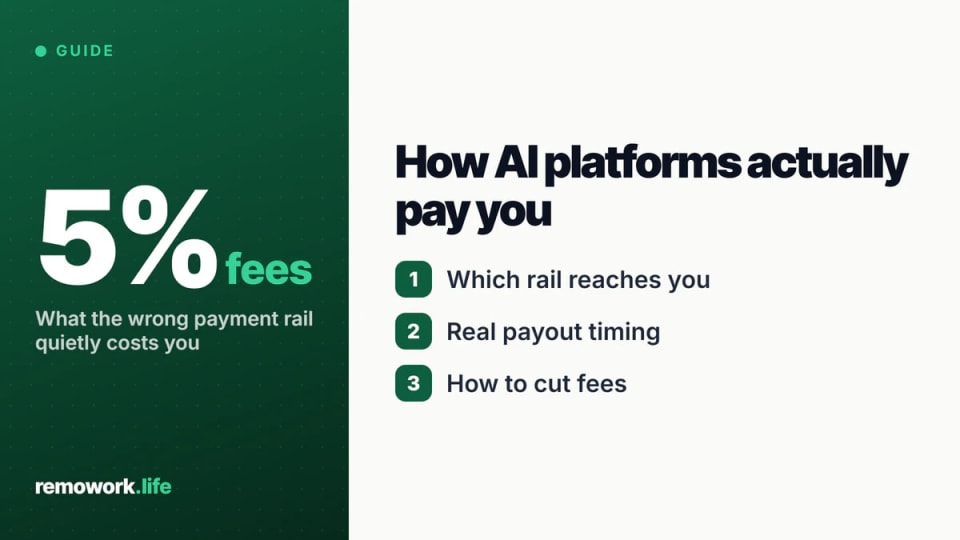
The most avoidable failure in this industry is earning money a platform cannot deliver to your country. Every platform rides a payment rail (AfterQuery on Stripe, Handshake and Alignerr on Deel, Mindrift on Payoneer, Outlier on a Hyperwallet-backed system), and rails have country gaps: Stripe cannot pay Nigeria or Bangladesh, PayPal cannot properly receive in several markets. Check your rails first, then choose platforms whose money can actually reach you.
The full platform-to-rail map, fee math, and the best route per country is in our How to Actually Get Paid guide. The short version: a verified Payoneer account plus a Wise account covers nearly everything, set both up while your balance is zero, and finish every identity verification before you earn, not after.
Step 3: Apply to 3 or 4 platforms in parallel
Not one. Not ten. Three or four from your track, applied to in the same week. The reason is the industry's defining rhythm: work arrives in client waves, and every platform has quiet weeks. Waves on different platforms are uncorrelated, so a 3-platform stack turns "no income this week" into "one platform is quiet, two are paying." Our own records make the case: one of our six AfterQuery applications was accepted while five sat under review, and our RemoExperts seat took 78 days to open, then produced a strong first active month. If we had applied to RemoExperts alone, those 78 days would have been $0 months.
Complete every profile field on every platform: languages, domains, credentials, devices. Waves filter on those fields, and an empty profile is invisible to batches that would have taken you. Why queues sit empty and how allocation really works is covered in Accepted but No Tasks, read it before your first quiet week, not during.
Step 4: How to pass the AI training qualification tests
Almost every rung-2+ platform gates entry with an assessment: RemoExperts' REX entry exam, Mindrift's adaptive domain test, Outlier's onboarding tasks, Mercor's AI interview, Micro1's Zara interview. They test the same three things: instruction-following, attention to detail, and clear written reasoning. The single highest-value habit is reading every instruction twice; the assessments are designed to punish skimmers.
Our acceptance guide covers each platform's test format and the preparation that works. Two rules from our own passes: never rush (speed earns nothing, accuracy decides everything), and match the project's vocabulary in written answers, if the client wants "evaluation against a rubric," use those words.
Step 5: Treat your first 30 days as an audition
Approval is not the finish line; it is the start of the scoring. Platforms track approval rates and quality scores from your first task, and those scores decide queue priority: proven contributors see new waves first, new accounts see leftovers. RemoExperts formalizes this in its Superhuman Profile, Mindrift unlocks advanced tasks by performance, and every platform does a version of it silently.
- Do fewer tasks, perfectly. A 96% approval rate on 20 tasks beats 75% on 60, and compounds for months.
- Reread the guidelines every session. They change mid-project, and "didn't see the update" is the most common rejection.
- Bill honest time on tracked platforms. Hubstaff-style monitoring (RemoExperts) pays you for reading instructions; use it, never game it.
- Withdraw early and screenshot everything. First payouts take 2 to 4 weeks (Stripe holds the first one ~7 days). Confirm the pipe works while the amount is small.
Step 6: Fill your hours, then raise your rate
Growth comes in that order. First fill your target hours at your current rung by adding a platform when your stack runs quiet. Only then chase the next rung: apply to one higher-tier track per month, using the work history you are building as evidence. The skills that move you up fastest, in rough order of return: coding (rung 2 → 3 overnight where you can pass a code evaluation), a second language (multilingual tracks pay premiums and have thinner competition), and any professional domain you can credential (rung 4 pays 3 to 10x rung 2, see the expert networks).
Step 7: Run it like a job, loosely
The contributors who reach $1,000 a month share one boring habit: a schedule. Waves reward availability, and quotas fill in hours, so the person who checks their stack at the same two times daily catches batches the occasional visitor misses. A workable rhythm: a 15-minute morning check across all platforms (claim anything live), one focused 2 to 3 hour block on your best-paying open work, and announcement channels (platform Slacks and Discords) left on notify, that is where waves are announced before dashboards show them.
Step 8: Track, prune, and re-invest
Once money flows, run a monthly review: effective hourly rate per platform (earnings ÷ real hours including unpaid reading), then shift hours toward the winner. Apply the 30/60/90 rule to dead accounts (park them, never delete). Set aside tax money as you go: this is self-employment income everywhere, roughly 25 to 30% reserved is the safe habit for US contractors (1099-NEC arrives at $600+ per platform), with local equivalents elsewhere. And re-invest a slice of hours into the skill that buys your next rung.
Three real $1,000 stacks
Illustrative but honest: built from the verified pay bands in our reviews, at hours real people actually sustain.
The no-credentials stack
- Recording project: ~30 hrs/mo × $5 ≈ $150
- DataAnnotation general: ~20 hrs/mo × $25 ≈ $500
- Outlier general: ~15 hrs/mo × $20 ≈ $300
≈ $950/mo at ~16 hrs/week
Assumes you pass one rung-2 assessment within 2 months. Until then, expect $300–500.
The skilled stack
- RemoExperts: ~25 hrs/mo × $25 ≈ $625
- DataAnnotation coding: ~8 hrs/mo × $50 ≈ $400
- Mindrift (fills quiet weeks): variable
≈ $1,025/mo at ~8–10 hrs/week
Our own best RemoExperts month cleared this on its own; 25 hours a week is the conservative version.
The professional stack
- AfterQuery specialist: ~10 hrs/mo × $80 ≈ $800
- Expert network #2: ~4 hrs/mo × $60 ≈ $240
- Wave insurance: one rung-2 account parked
≈ $1,040/mo at ~3–4 hrs/week
Specialists in our PhD guide report $2,000–5,000/mo at 10–15 hrs/week across 2–3 networks.
What the months actually look like
| Month | What happens | Realistic income |
|---|---|---|
| Month 1 | Rails set up, 3–4 applications in, assessments taken. Some acceptances land in days (AfterQuery quotes 7–10), others sit under review for weeks. | $0–150 |
| Month 2 | First approved tasks; first payout clears its hold. Your approval rate starts compounding into queue priority. | $150–400 |
| Months 3–4 | Stack is live on 2–3 platforms; waves overlap instead of gapping. You add one higher-rung application per month. | $400–800 |
| Months 5–6 | A skilled track or a big wave lands (our 78-day RemoExperts wait paid off in month one of activity). The routine, not luck, gets you here. | $800–1,500 |
The month most people quit
Month 2. The novelty is gone, one platform is silent, and the first payout has not landed yet because of first-payment holds. Every documented success we have, including our own accounts, went through that exact trough. The stack and the routine exist precisely to carry you across it.
The five mistakes that reset people to $0
- Relying on one platform. One client wave ends and your income is $0 for weeks. The stack is not optional.
- Rushing tasks for volume. A damaged approval rate quietly moves you to the back of every future queue, the opposite of scaling.
- Skipping payment setup. Earning money Stripe cannot deliver to your country, or losing 4% of every payout to bad routing. Route it right.
- Quitting during a quiet week. Waves return. Parked accounts cost nothing; abandoned ones cost the queue priority you already earned.
- Paying anyone to join. Legitimate platforms never charge fees. Anyone selling "guaranteed acceptance" or "account activation" is a scam, full stop.
Frequently asked questions
How long does it take to earn $1,000 a month from AI training?
Three to six months for most people, faster for credentialed professionals who clear expert-network vetting (those tracks pay $80–250/hr, so $1,000 is 4 to 12 hours of work). The binding constraints are assessment passes, first-payout holds, and wave timing, not effort.
Can a complete beginner really do this?
Yes, on the beginner track: start on collection work that has no skill gate ($3–9/hr), then pass one general-platform assessment to reach $15–30/hr. The realistic beginner ceiling in the first months is $300–500/mo, growing as assessments pass. Strong written English is the one non-negotiable skill.
Is AI training income stable enough to rely on?
As supplemental income, yes, with a 3–4 platform stack smoothing the waves. As a sole income, we do not recommend it: work arrives in client-driven batches on every platform, and quiet weeks are structural, not a sign you did something wrong.
Do I pay taxes on AI training income?
Yes, everywhere. This is self-employment income: US contractors receive a 1099-NEC from each platform paying $600+, and other countries have equivalents whether or not paperwork arrives. Reserve roughly 25–30% as you earn and keep your own records; platforms' histories are not always exportable later.
Which platform should I start with today?
By track: no credentials → DataAnnotation plus a recording project; skilled or bilingual → RemoExperts and Outlier; degree or license → AfterQuery and the expert networks. Whatever you choose, apply to three at once; single applications are how people end up waiting alone through a 78-day queue.
Do I need experience to start AI training work?
No for the entry track. Generalist evaluation and data-collection work gate on a short assessment, not a degree or a portfolio. You build an approval record on beginner tasks, then use it to reach the higher-paying specialist tiers that do want credentials. Strong written English is the one skill you cannot skip.
How do I get my first AI training job?
Set up your payment rail, apply to three or four beginner-friendly platforms in the same week (DataAnnotation, Outlier, plus a recording project), complete each profile fully, and pass the short assessment. Read every instruction twice; the assessment rewards exactly that. Your first approved tasks usually follow within two to four weeks.
How much can a beginner realistically earn training AI?
In the first months, about $300 to $500 a month on entry-level work ($3 to $30 an hour), growing as you pass assessments and unlock skilled tiers. Reaching $1,000 a month typically takes three to six months of stacking platforms and protecting your approval rate.
Sources & how to verify this
- First-hand (primary): our documented earnings and timelines: paid work on RemoExperts (review with screenshots), $740 on AfterQuery (review with payment history), and accounts on Mindrift, DataAnnotation, CrowdGen, OneForma, SME Careers, and Handshake.
- Pay bands: the verified rates in our individual platform reviews and the Top 25 guide; stack math uses those figures at conservative hours.
- Deep-dives this roadmap links into: payment rails, wave mechanics, acceptance guide, and the egocentric data guide.
Rates and platform behavior change with client demand. This roadmap was last verified in July 2026 against our live accounts, and we update it as the market moves.
The bottom line
$1,000 a month from AI training is a systems outcome, not a lucky break: rails first, three or four platforms, assessments taken seriously, a protected approval rate, a boring routine, and patience through month 2. The ladder is real, we have climbed enough of it to publish the receipts, and the demand side (frontier labs buying human judgment at industrial scale) is still growing. Start on your track today, and let the stack do what no single platform will: pay you every week.
Build Your Stack Today
Verified pay, payout methods, and country eligibility for every platform in this roadmap, plus live AI training jobs updated daily.