AfterQuery is the AI training platform everyone in the expert-data world is suddenly talking about: Y Combinator W25, a $30M Series A at a reported $300M valuation, roughly $100M in annualized revenue, and job ads promising up to $250 per hour for PhD-level specialists. Those numbers raise the obvious questions. Is AfterQuery legit? Are the premium rates real? And is the expert track worth applying for?
This AfterQuery review is written from inside the platform. I applied, passed the assessment, completed paid projects, and got paid, so alongside the research you'll see screenshots of my actual dashboard, earnings, and payment history. Here's the honest picture: what AfterQuery Experts pays, how the application really goes, where the money lands (and which countries it can't reach), and who should skip it.
AfterQuery at a Glance
Our Verdict
4.0/5 for credentialed pros
Pay Range
$10/task to $250/hr advertised
Payment
Weekly Fridays via Stripe
Best For
Specialists with 3+ yrs experience
What Is AfterQuery Experts?
AfterQuery is a San Francisco applied research lab (founded January 2025 by Spencer Mateega, Carlos Georgescu, and Danny Tang) that builds expert-generated training data and reinforcement-learning environments for frontier AI labs. Instead of hiring armies of general annotators, it recruits practicing professionals (engineers, physicians, lawyers, analysts, researchers, writers) to create and evaluate the hard material AI models struggle with, then sells that data to labs. It claims a network approaching 100,000 experts, says every US frontier AI lab is a customer, and in July 2026 publicly named NVIDIA as a client engagement on OpenAI's GDPval benchmark.
The investor list explains the hype: the April 2026 Series A was led by Altos Ventures with participation from The Raine Group and Y Combinator, plus angels from Google DeepMind, OpenAI, Anthropic, Meta, and Microsoft AI. The stated use of funds was growing the expert network first, which is why hiring has been aggressive across so many fields. AfterQuery also appears at #12 in our Top 25 AI training platforms guide.
My Experience: Inside a Real AfterQuery Account
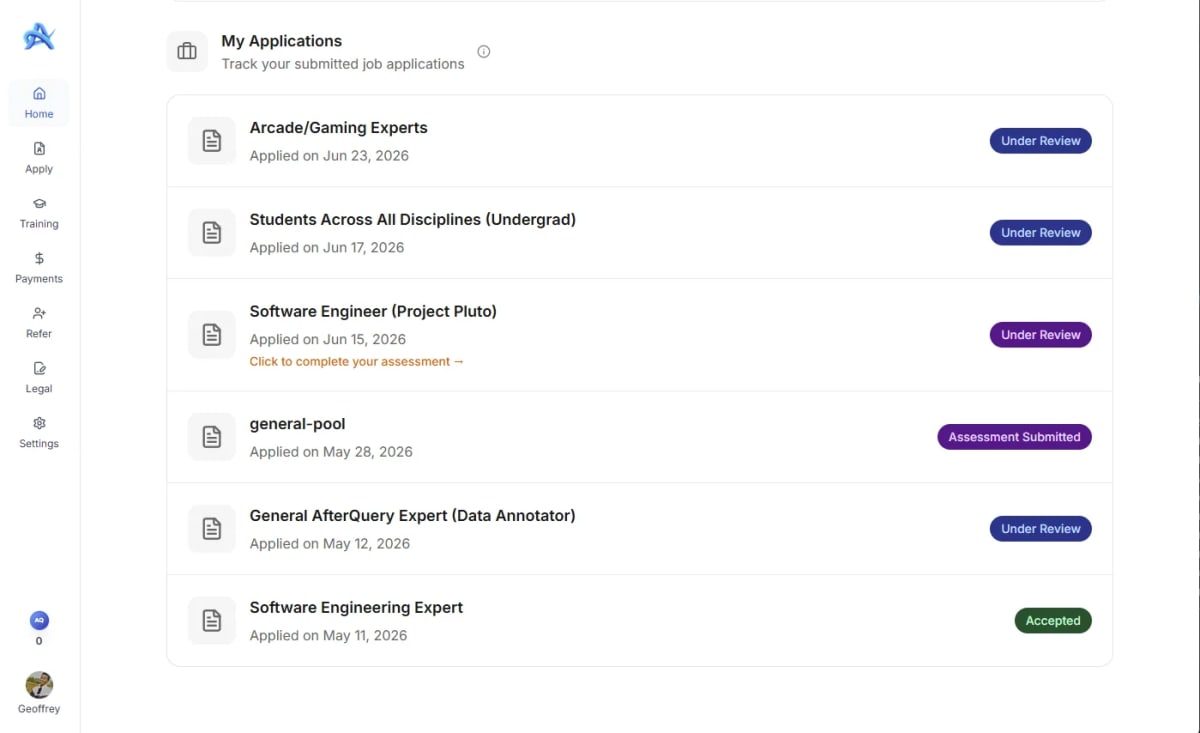
I applied to AfterQuery in May 2026. Here's the timeline from my own applications tracker: I submitted six applications across different tracks between May 11 and June 23. One (Software Engineering Expert, applied May 11) was accepted. The rest sat "Under Review" for weeks, one still pending an assessment, which tells you two things: acceptance is genuinely selective, and the review queues are slow.
Once accepted, the dashboard shows your eligible projects. Mine currently lists three active ones: a coding-evaluation project and two per-task projects paying $10 per approved task.
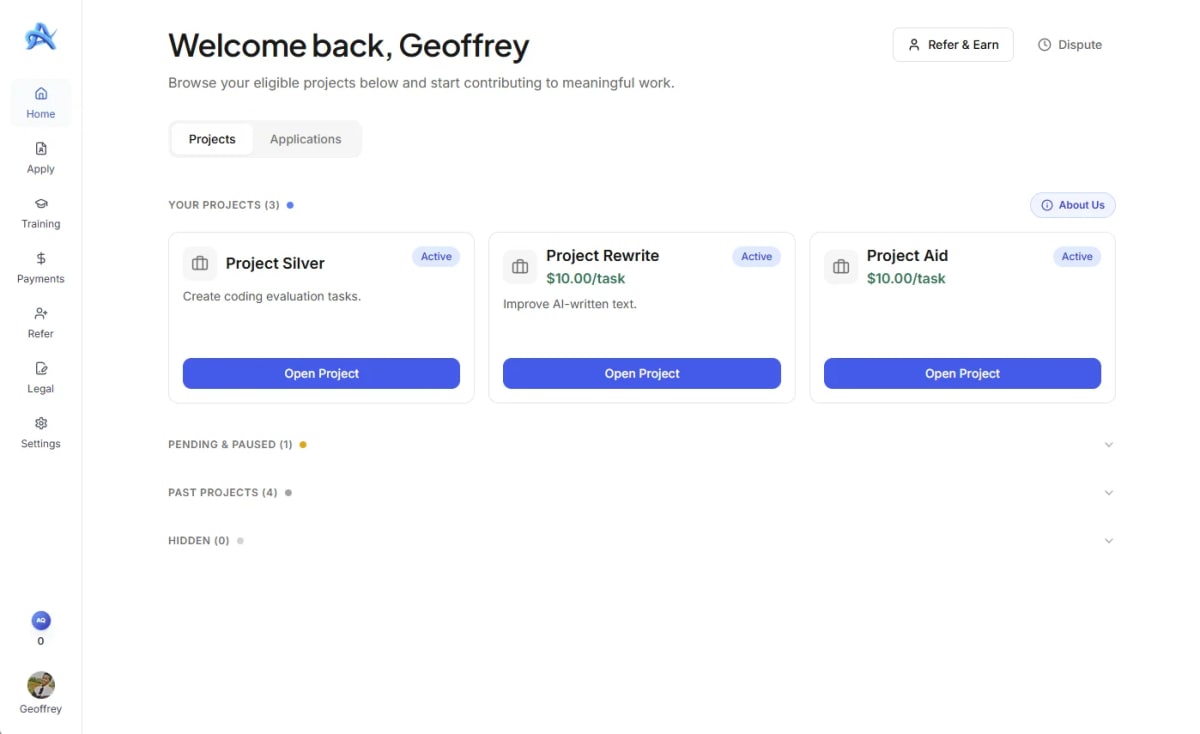
Inside a project, tasks are claimed from a queue, and this is where you feel the wave pattern contributors describe: when a batch is live you can work steadily, and when it's exhausted the queue shows zero and you wait. On one writing project I completed 25 tasks, had 24 approved, and earned $365, with the platform banner announcing "Payday is Friday."
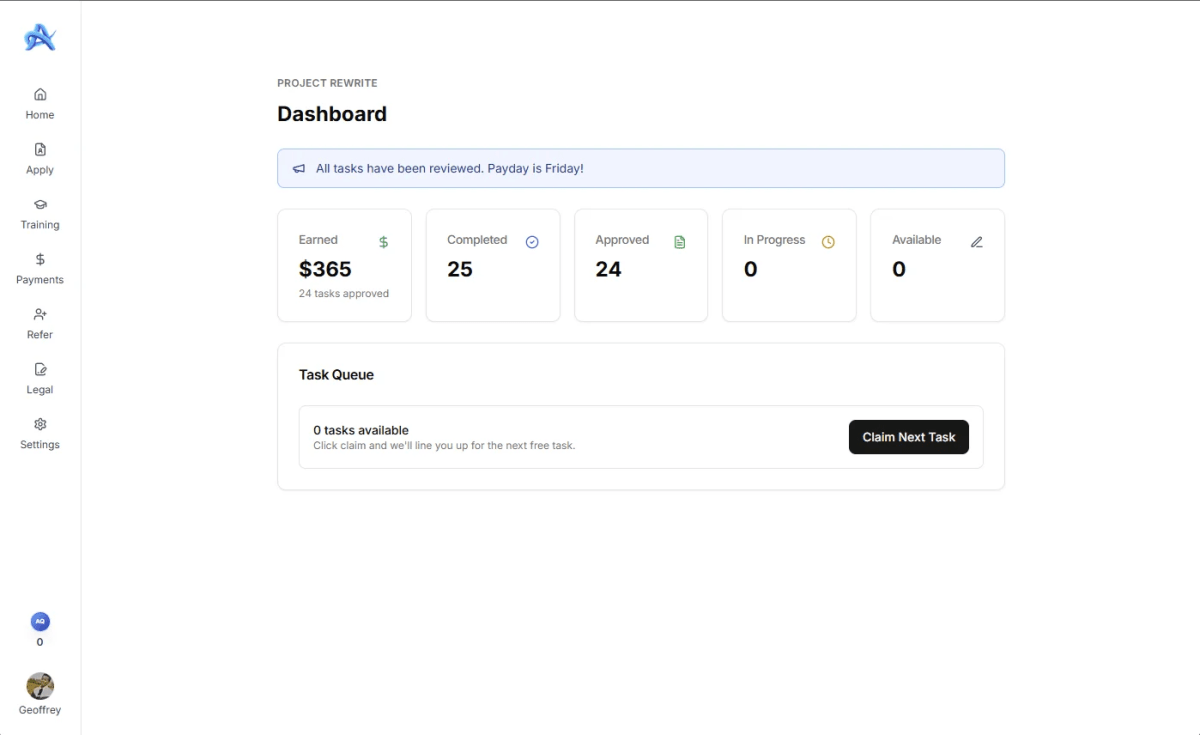
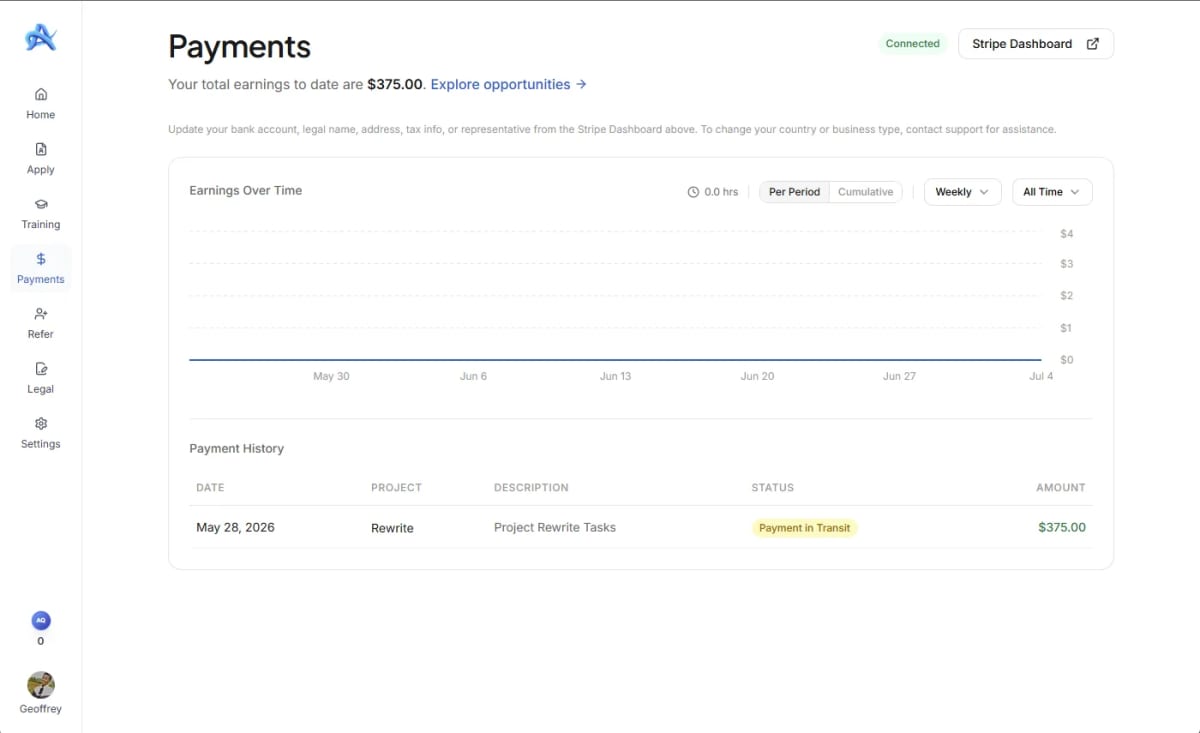
Payments run through Stripe, connected directly from the Payments tab. My history shows the payout leaving on schedule.
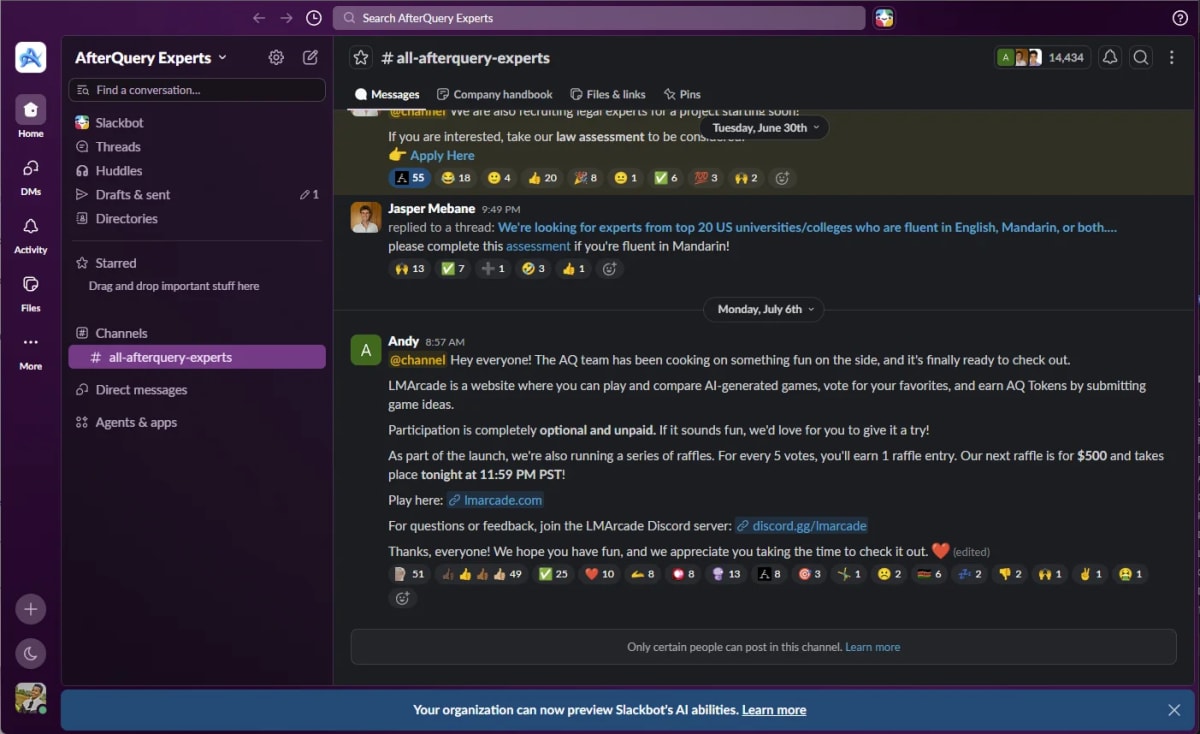
One more thing most reviews miss: a lot of AfterQuery's real activity happens in its expert Slack, which had 14,434 members when I captured this. New project recruitment (legal experts, Mandarin speakers, and more) is announced there with assessment links, so joining the Slack and watching announcements is genuinely part of the job.
How to Sign Up for AfterQuery (Step by Step)
Apply once at the expert portal
Submit personal details, work history, availability, and an interest statement at experts.afterquery.com. You can apply to a specific role or the general expert pool; confirmation lands within 24 hours.
Complete the skills assessment within 48 hours
The invitation has a 48-hour window, so watch your inbox. Expect language proficiency, attention-to-detail checks, sample annotation tasks, and domain-specific tests for specialist tracks. Our acceptance guide covers how to prepare.
Interview and identity verification
A 15–30 minute discussion covering your background, scheduling, and compensation, plus ID verification for specialist roles. Some tracks run this asynchronously.
Onboarding, training, and Stripe setup
Mandatory training modules, quality-standard docs, and payment setup. AfterQuery quotes 7–10 days from application to first paid work; my experience says budget longer if your track's queue is busy.
AfterQuery Pay: What You'll Actually Earn
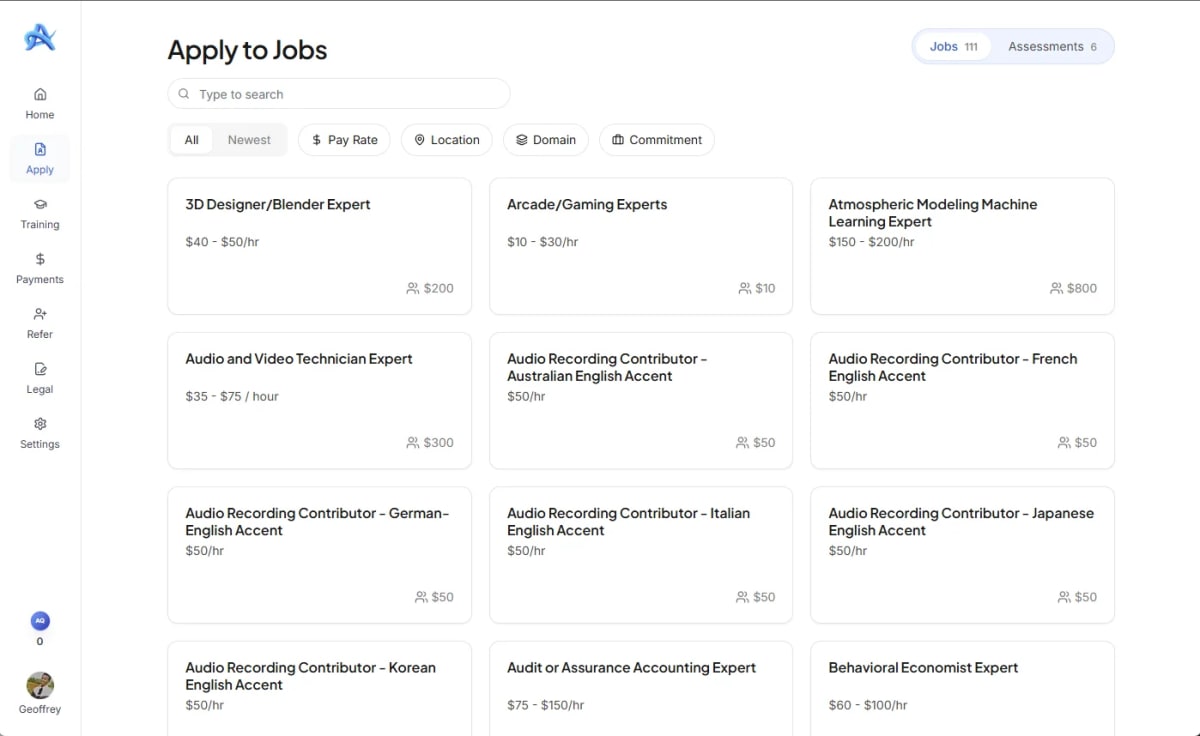
Think of AfterQuery pay as a pyramid. At the base are per-task projects like the $10/task writing and evaluation work in my dashboard. In the middle are hourly generalist and technical roles with advertised rates of $25–$75/hr. At the top are credentialed specialist roles: I verified live postings at $80–$120/hr (Financial Analyst, US-only) and $150–$200/hr (Atmospheric Modeling ML Expert on my jobs board), with recruiting ads reaching $180–$250/hr for rare, top-credentialed specialties. Those top rates are real listings, but they are the peak, not the average.
| Tier | Rate | Examples (verified July 2026) |
|---|---|---|
| Per-task projects | ~$10/task | Rewrite/improve AI text, evaluation tasks (my dashboard) |
| Generalist hourly | $25–$75/hr | Software engineer $25–$50, eCommerce $30–$70, audio contributors $50, A/V technician $35–$75 |
| Credentialed specialist | $80–$200/hr | Financial Analyst $80–$120 (US only), Atmospheric Modeling ML $150–$200, accounting $75–$150 |
| Top advertised | $180–$250/hr | Rare specialties in recruiting ads; treat as ceiling, not expectation |
Payment mechanics (verified):
Payments go out every Friday (by 11:59 p.m. Pacific) for work approved in the prior Monday–Sunday period, through Stripe to bank accounts only; no PayPal, no cards, no minimum threshold. Stripe holds your first payout for 7 days, and banks take 2–3 business days after that, so expect your first money roughly 2–3 weeks after you start. US contractors get a 1099-NEC at $600+. Per-task work must pass review before it qualifies for payment.
Check Your Country Before You Apply
AfterQuery pays into 100+ countries including Kenya, India, South Africa, the UAE, and most of Europe and the Americas. But its unsupported list matters: Nigeria, Brazil, Argentina, Egypt, Ghana, Bangladesh, Colombia, Japan, South Korea, and Saudi Arabia (among others) cannot receive payouts. If you're in one of those countries, don't spend hours on assessments; start with platforms that pay there instead, like the options in our Top 25 guide.
Is AfterQuery Legit?
Yes. The payments are real (mine included), the infrastructure is professional, and the company's client list and funding are publicly documented. There is no pattern of non-payment for approved work. That said, an honest review has to include the friction contributors report, and I've felt some of it myself:
- Rejection opacity. Some contributors report tasks rejected as "already in database" with no criteria disclosed beforehand, and there is no documented appeal process for rejected work.
- Undisclosed task caps. One doctoral researcher recruited at an advertised $100–$180/hr reported hitting caps that weren't in the job description, earning far less than expected on day one.
- Wave droughts. Projects open and close fast (several roles I tracked went from live to closed within weeks), and empty claim queues are normal between waves.
- Heavy-handed community moderation. Criticism in the company-run Reddit community has reportedly led to bans, and one project's Slack channel was archived amid unresolved complaints.
Weigh those against the positives: pay rates that lead the industry at the specialist tier, weekly Stripe payouts with no minimum, an "apply once" model, a public commitment not to train on unpaid or rejected data, and enough client demand ($100M run rate, NVIDIA engagement) that new project waves keep coming.
Pros and Cons
Pros
- ✓ Industry-leading specialist rates ($80–$200/hr verified on live postings)
- ✓ Weekly Friday payouts via Stripe with no minimum threshold
- ✓ Apply once; then dashboard projects and direct invitations
- ✓ Intellectually engaging work: real reasoning, evaluation, and domain problems
- ✓ Well-funded with real frontier-lab clients, so demand keeps flowing
- ✓ Referral bonuses from $20 up to $800 per successful expert referral
Cons
- ✗ Selective and slow: my applications sat "Under Review" for weeks
- ✗ Wave-based work; income is bursty, not steady
- ✗ No documented appeal process for rejected tasks
- ✗ Task caps and rejection criteria aren't always disclosed up front
- ✗ Bank-only Stripe payouts exclude Nigeria, Brazil, Egypt, Ghana, and more
- ✗ Top advertised rates apply to a small set of rare specialties
Who Should (and Shouldn't) Apply
Apply if you are
A PhD or graduate researcher, practicing physician, lawyer, finance professional, ML engineer, experienced software developer, or any specialist with 3+ years of provable domain experience, in a supported payment country, who wants premium-rate project work alongside a main income. PhD holders should also read our guide to AI platforms for PhDs.
Skip it if you are
A beginner without professional credentials (the general pool exists but queues are long and per-task rates modest), someone who needs steady weekly income (waves make that unreliable), or based in an unsupported payment country. Better starting points: DataAnnotation, Outlier, or the broader options in our Top 25 guide.
Frequently Asked Questions
Is AfterQuery legit?
Yes. It's a Y Combinator-backed company with $30M in funding, roughly $100M in annualized revenue, frontier AI labs (including NVIDIA) as clients, and real weekly payments via Stripe; I've been paid myself. The legitimate criticisms are about rejection transparency, undisclosed task caps, and bursty work availability, not about whether it pays.
Can you really earn $250/hr on AfterQuery?
The top advertised rates ($180–$250/hr) appear in recruiting ads for rare, top-credentialed specialties. On live postings I verified $80–$120/hr (finance) and $150–$200/hr (specialized ML). Most contributors will earn from per-task projects (~$10/task) or generalist hourly roles ($25–$75/hr). The ceiling is real; just don't mistake it for the average.
How does AfterQuery pay?
Weekly, every Friday by 11:59 p.m. Pacific, for work approved in the prior Monday–Sunday period. Payments go through Stripe to bank accounts only (no PayPal), with no minimum payout. Stripe holds the first payout 7 days, so your first payment takes roughly 2–3 weeks. US contractors receive a 1099-NEC at $600+.
Does AfterQuery work in my country?
It pays into 100+ countries, including Kenya, India, South Africa, the UAE, and most of Europe and the Americas. Notable exclusions: Nigeria, Brazil, Argentina, Egypt, Ghana, Bangladesh, Colombia, Japan, South Korea, and Saudi Arabia. Your bank account country must match your registered location.
How long does AfterQuery take to accept applicants?
AfterQuery quotes 7–10 days from application to first work: application, a skills assessment you must complete within 48 hours of the invite, a 15–30 minute interview, then onboarding. In practice it varies a lot by track; of my six applications, one was accepted within days while others sat under review for over a month.
Do I need a PhD to join AfterQuery?
No. There's a general expert pool (data annotation, writing, evaluation) plus roles for undergraduates and working professionals. But the premium rates are reserved for advanced credentials: published research, professional licenses, or deep niche experience. The platform-level bar most roles cite is 3+ years of specialized professional experience.
Is AfterQuery work consistent?
No, and it doesn't pretend to be. Work arrives in project waves, typically 2–3 week assignments at 10–20 hours per week, followed by quiet periods with empty task queues. Treat AfterQuery as high-rate supplemental income and pair it with steadier platforms if you need reliable weekly earnings.
Final Verdict: 4.0/5 for Credentialed Professionals
AfterQuery is the real thing: real clients, real specialist rates, and payments that arrive every Friday, which my own account confirms. It is also selective, bursty, and occasionally opaque about rejections and caps, and its bank-only payouts exclude some major countries. If you have provable domain expertise and patience for the wave rhythm, it belongs at the top of your list; the $250/hr headline is a genuine ceiling for rare specialists, not a promise. Beginners should build a track record on broader platforms first, then come back.
Ready to try it? Apply at experts.afterquery.com, and complete that assessment within the 48-hour window.
Find Your Next Expert AI Opportunity
RemoWork tracks verified AI training roles across every major platform, from entry-level annotation to $200/hr specialist contracts.
.png?updatedAt=1755647850953) G
G