Most people searching for OneForma are trying to answer one question before anything else: who actually owns this thing? The name has changed corporate hands twice, and the internet cannot agree on the answer. This review settles that from OneForma's own paperwork, then covers what the work really pays, why approval takes far longer than anyone tells you, and the payment rules that catch people out.
The quick answer: OneForma is legit and it is owned by Centific, formerly Pactera EDGE. Real project rates we have seen on our own account run from $9 to $12 an hour, with some work priced per segment and some quoted in local currency. The two things nobody warns you about: getting approved is a five-stage process that can take months, not weeks, and PayPal is capped at USD 300 per year, so you will need Payoneer or Tipalti if you plan to earn more than that.
OneForma at a Glance
Owned by: Centific, formerly Pactera EDGE
Observed pay: $9 to $12/hr, some work per segment
Payment: Twice monthly, $10 minimum
Best for: Multilingual work, especially outside English
The screenshots below come from an account we hold that is still working its way through OneForma's approval pipeline, which is exactly why it is useful: it shows the part between signing up and earning that no other review documents. Account names have been removed.
What Is OneForma?
OneForma is a global crowdsourcing platform for AI training data. Enterprise clients fund projects, and freelancers around the world do the actual work: annotating data, transcribing audio, translating, evaluating search results, recording speech, and collecting video. It launched in 2019 and is run out of Redmond, Washington.
Its public job board carries six task categories, and they are broader than most people expect.
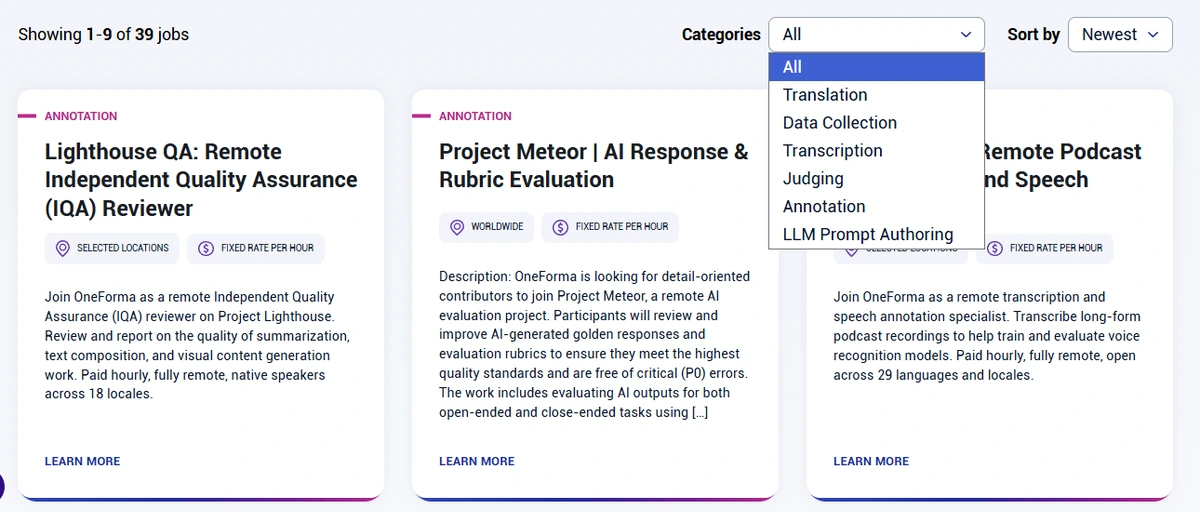
Projects carry code names rather than client names, which is why you will see people asking about Project Lighthouse, Project Meteor or Project Fred without much context. Across the roles we track there are dozens: Freya for podcast transcription, Hermes for language specialists, Zeno for speech translation quality, Triangle for ego-centric video, Harbor for red teaming, and Slice, which recruits board-certified radiologists in the United States.
Who Owns OneForma? Settling the Confusion
This is the question driving most OneForma searches, and the answer is in OneForma's own job listings rather than anywhere on its marketing site. At the bottom of every job page is this disclaimer:

So the chain is: Pactera, then Pactera EDGE, now Centific. The corporate parent has been renamed twice; OneForma has stayed the contributor-facing brand throughout. That is a rebrand history, not an ownership problem, and the same job page confirms it operationally by noting that annotation credentials are "provided by Centific".
One more clarification, because it comes up constantly: OneForma is not TELUS International. Some sources claim it is. They are separate companies that happen to run similar generalist AI-training and rater programmes, which is why they get confused. We cover the other one in a separate TELUS International review.
What OneForma Actually Pays
OneForma prices per project, not per platform, so a single headline rate would be misleading. Here is what was actually showing on our account.
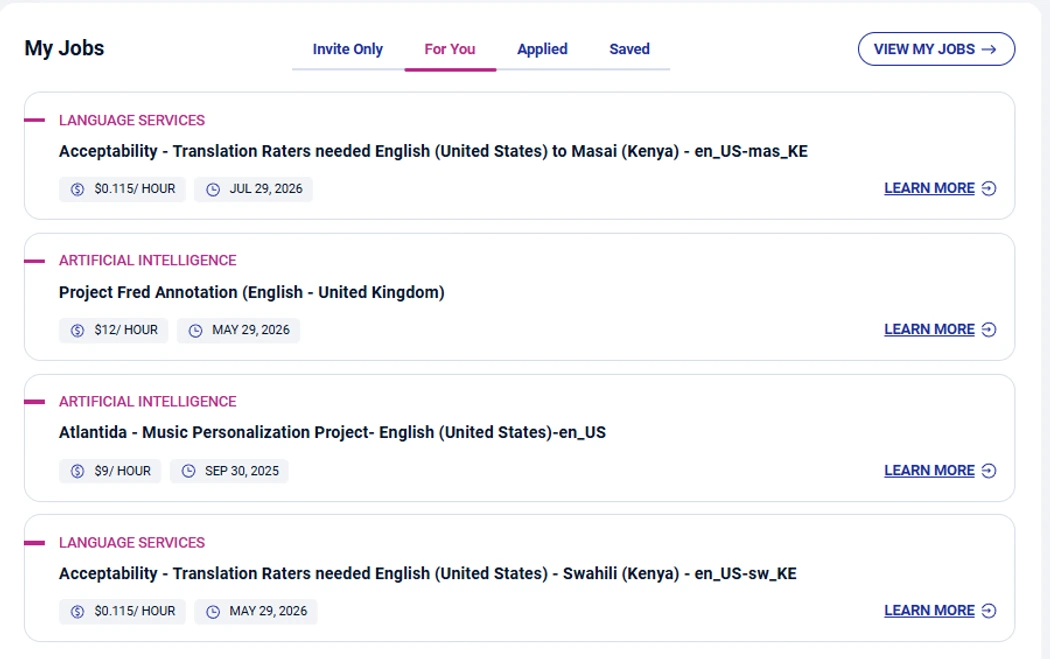
About that $0.115 an hour
Both English-to-Swahili and English-to-Masai translation-rater roles displayed a rate of $0.115/HOUR. We are not going to pretend we can explain it. It is almost certainly a per-item rate being shown with an hourly label rather than a genuine offer of eleven cents an hour, but OneForma does not say so anywhere on the card. Open the project and read the brief before accepting anything priced like this, and treat the displayed unit as unreliable until the project page confirms it.
Rates are also quoted in other units and other currencies entirely. On the logged-in job board we saw work priced per segment and priced in yuan.
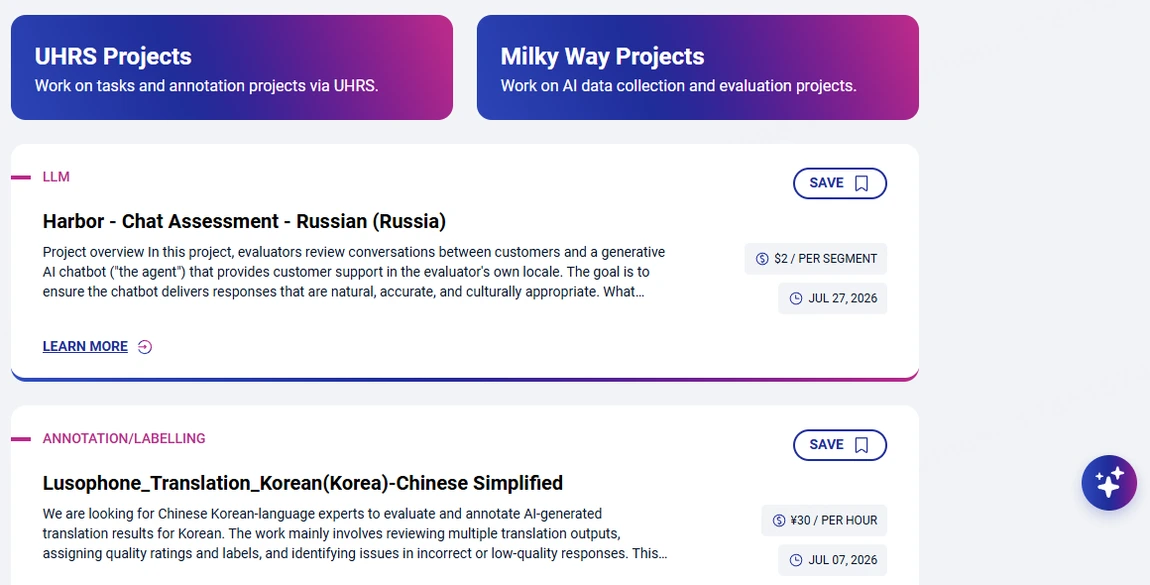
Those two tiles matter. UHRS is the crowd platform behind a lot of search and relevance rating work, and OneForma is one of the vendors that routes people into it. Milky Way is its own AI data collection and evaluation programme. The UHRS micro-task listings we track advertise roughly $8 to $20 an hour, which is the widest band on the platform and the one most people actually end up working.
The Application Pipeline, and How Long It Really Takes
Signing up is not the same as being able to work. Applying to a single project runs through five stages.
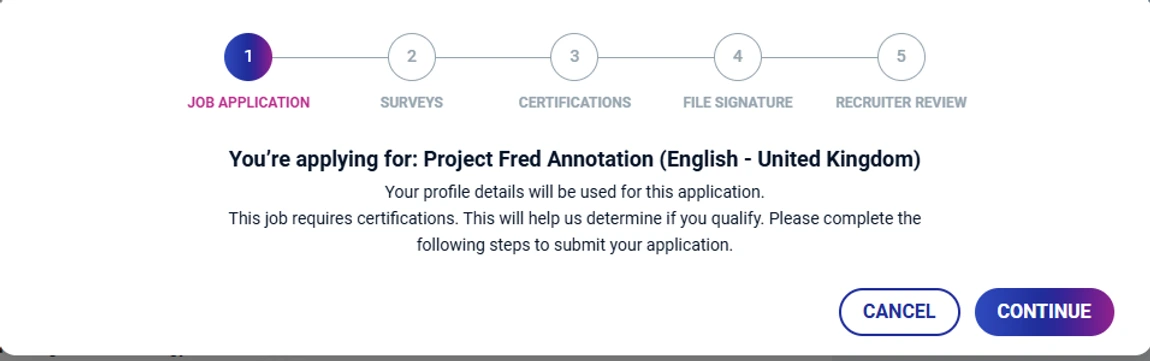
You will read elsewhere that approval takes one to four weeks. Our own account says otherwise.
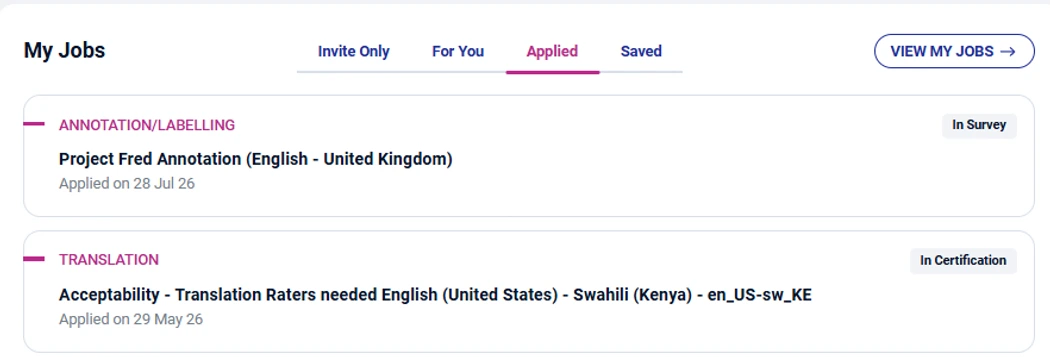
Individual projects also gate on things you cannot fix quickly. Project Fred, at $12 an hour, required a native United Kingdom English speaker, at least a year of annotation experience, and access to a macOS machine. Read the requirements before you spend an evening on certifications you cannot use.
How You Actually Get Paid
This is where OneForma differs most from the task platforms it gets compared to, and where the rules are strictest. Payment is not monthly, and it is not automatic.
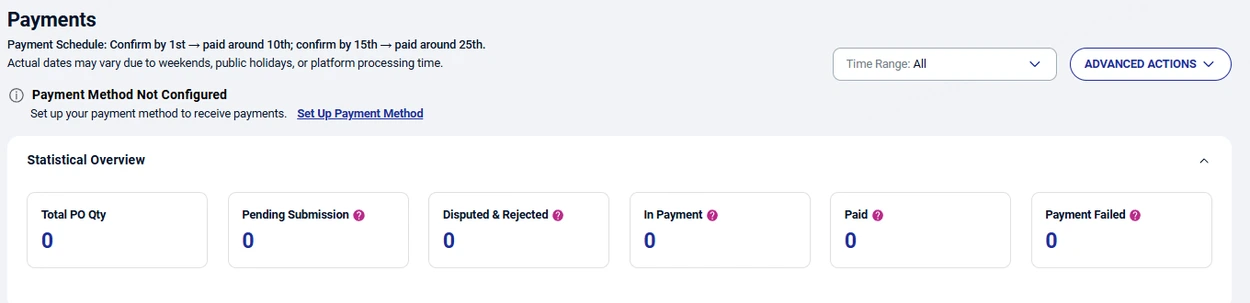
The word "confirm" is doing a lot of work there. OneForma runs on purchase orders and invoices that you have to confirm before they enter the payment run. Miss the cutoff and your money waits for the next window. The dashboard tracks each one through Pending Submission, In Payment, Paid, Disputed and Rejected, and there is a Disputes tab because rejections happen.
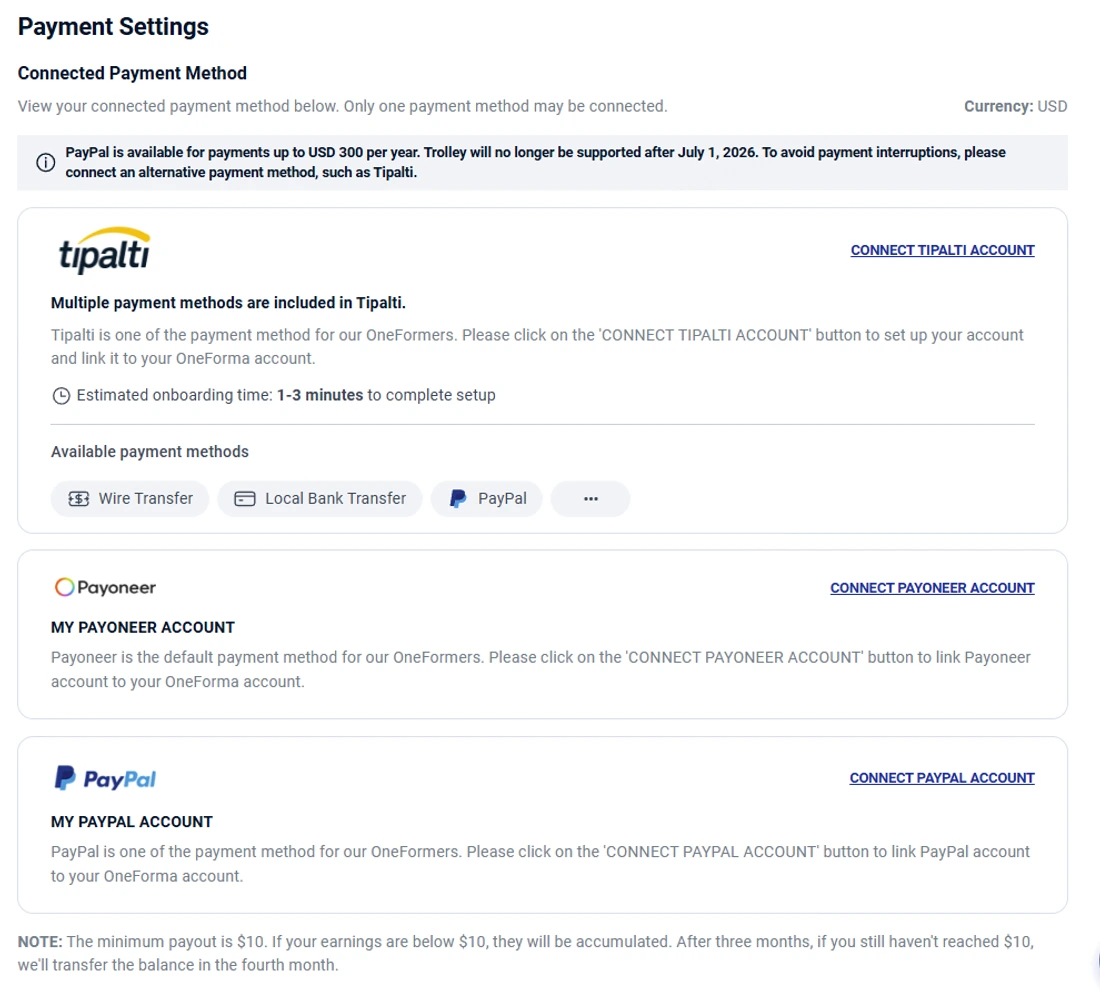
- PayPal is capped at USD 300 a year. If you intend to earn more than that, connect Payoneer or Tipalti from the start rather than hitting the ceiling mid-year.
- Payoneer is the default rail. Tipalti covers wire transfer and local bank transfer, and OneForma quotes one to three minutes to set up.
- The minimum payout is $10. Below that your balance accumulates, and if you still have not reached $10 after three months, it is paid out in the fourth.
- Only one payment method can be connected at a time, and nothing pays out until it is configured.
The Honest Caveats
Three things to go in expecting. First, the gap between signing up and earning is long, and it is the single most common reason people give up on OneForma. Second, work arrives in project waves rather than steadily, so an approved project can go quiet, which is the pattern we cover in our guide to why AI training income is seasonal. Third, the pay is mid-tier, not top-tier: $9 to $12 an hour is respectable for accessible remote work but well below the specialist platforms.
The compensating advantage is language breadth. OneForma runs projects across a claimed 300+ languages and 222 markets, and the roles we see include Swahili, Masai, Catalan, Korean, Portuguese and Hindi work that simply does not exist on English-first platforms. If you speak something other than English natively, that is the reason to bother.
OneForma vs the Alternatives
OneForma sits in the accessible, global, mid-pay tier. Its nearest peer is CrowdGen by Appen, and it competes with the platforms in our Toloka, Clickworker and Microworkers comparison. Against those, OneForma pays better per hour and offers more serious project work, but it makes you wait far longer to start.
If you have a professional credential, the specialist platforms pay more. If you want to be working this week, a platform with instant task access will serve you better. See the full field in our roundup of AI training platforms that pay.
Is OneForma Worth It?
Worth it if you
- Speak a language other than English natively
- Can apply now and wait weeks or months to start
- Want project work rather than endless microtasks
- Are happy to run it alongside something steadier
Skip it if you
- Need to be earning this week
- Only work in English and want the highest rate
- Cannot deal with confirming invoices on a deadline
- Expected to be paid through PayPal at any volume
The verdict: OneForma is a real platform run by a real company, and the rates on genuine projects are fair. What it asks in exchange is patience. Apply to several projects at once so the certification waits overlap rather than run end to end, connect Payoneer or Tipalti before you earn anything, and treat it as one income stream among several. If the work goes well it is worth putting on your resume properly.
Frequently Asked Questions
Is OneForma legit?
Yes. OneForma is part of Centific, a global technology services company with enterprise clients, and it states so on its own job pages. It launched in 2019 and operates out of Redmond, Washington. The realistic complaints are about how long approval takes and how modest the pay is, not about whether the company is real.
Is OneForma the same as Centific or Pactera EDGE?
Yes, they are the same organisation at different points in its history. The parent was Pactera, then Pactera EDGE, and is now Centific. OneForma has remained the contributor-facing brand throughout, which is why searches for "OneForma by Centific" and "OneForma Pactera EDGE" both point at the same platform.
Is OneForma the same as TELUS International?
No. They are separate companies. OneForma is part of Centific; TELUS International is a Canadian company with its own AI-training and rater programmes. They get confused because both run similar generalist, global data work, but there is no ownership relationship between them.
How much does OneForma pay?
It depends on the project. On our own account we saw $12 an hour for annotation work and $9 an hour for a music personalisation project, while UHRS micro-task listings advertise roughly $8 to $20 an hour. Some work is priced per segment, for example $2 per segment on a chat assessment project, and some is quoted in local currency such as ¥30 per hour. There is no single platform-wide rate.
How long does it take to get approved on OneForma?
Longer than most guides claim. Each project runs through five stages: job application, surveys, certifications, file signature and recruiter review. On the account we hold, an application submitted on 29 May was still at the certification stage on 4 August, more than two months later. Apply to several projects at once rather than waiting on one.
When does OneForma pay?
Twice a month, and only after you confirm your invoice. Confirm by the 1st and you are paid around the 10th; confirm by the 15th and you are paid around the 25th. The minimum payout is $10, with smaller balances accumulating and being released in the fourth month if they still have not reached the threshold.
Can I get paid by PayPal on OneForma?
Only up to USD 300 per year. Above that you need an alternative, and OneForma points people to Tipalti, which covers wire and local bank transfer. Payoneer is the default method. Trolley was supported previously but was retired after 1 July 2026, and only one payment method can be connected at a time.
See What OneForma Is Hiring For
Live OneForma projects across transcription, translation, annotation and data collection, plus the rest of the platforms paying right now.
Sources and How to Verify This
- Measured by us: the $12, $9 and $0.115 hourly figures, the $2 per segment and ¥30 per hour rates, the five-stage application flow, the 29 May application still in certification on 4 August, the twice-monthly payment schedule, the USD 300 PayPal cap and the $10 payout floor are all read from an account we hold and from OneForma's public job board, screenshotted above.
- From OneForma directly: the ownership statement is quoted verbatim from the disclaimer at the foot of a live OneForma job page, and the same page attributes annotation credentials to Centific.
- Redaction: OneForma applies a faint tiled watermark containing account identifiers across its logged-in pages. It was removed from every screenshot before publication, along with the account holder's name.
- Project and role counts reflect OneForma's public board and the listings live on RemoWork at the time of writing, and change as projects open and close.