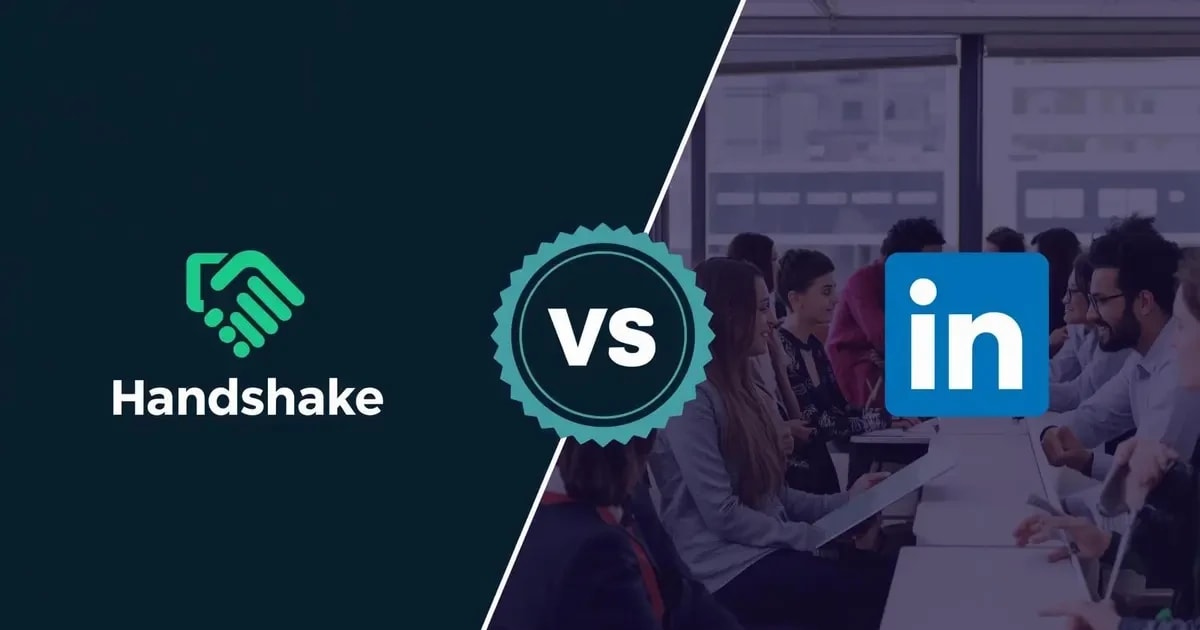
Remote work is no longer a pandemic-era experiment — it's a permanent fixture of the global labor market. In 2026, roughly 20% of U.S. job postings on LinkedIn offer remote or hybrid options, and over 65 million people browse job opportunities on the platform every week. Meanwhile, Handshake — the career platform integrated into 92% of U.S. universities — serves 22 million students and young professionals looking for their first roles.
If you're searching for remote work, you've almost certainly encountered both platforms. But they serve fundamentally different audiences, offer different tools, and deliver different results depending on where you are in your career. This comparison breaks down exactly how each platform works for remote job seekers, with real data, honest trade-offs, and a clear recommendation based on your situation.
At a Glance
| Feature | Handshake | |
|---|---|---|
| Target audience | Students & recent graduates | All professionals (intern → CEO) |
| User base | 22 million students | 1.2+ billion members globally |
| Remote job volume | Growing, mostly entry-level | Tens of thousands, all levels |
| Recruiter behavior | Campus-cycle recruiting | Active outreach year-round |
| Personal branding | Limited (academic focus) | Strong (posts, articles, endorsements) |
| AI features (2026) | MOVE program, Fit Check, AI sourcing | AI job matching, writing assistant |
| Best for remote work | Entry-level & internships | All experience levels |
How Each Platform Works
Handshake
Handshake was built to connect university students and recent graduates with employers. It partners directly with 92% of U.S. universities and integrates with career services offices, making it the default recruiting platform at most campuses. Your school email is your ticket in — profiles are linked to your academic institution, and employers specifically target students from partner schools.
The platform emphasizes structured pathways: internship programs, campus recruiting events, employer webinars, and entry-level roles with clear onboarding. In 2026, Handshake also runs the MOVE (Model Validation Expert) program, connecting graduate students with paid, remote AI training projects for leading AI labs at $22–$300+/hr.
LinkedIn is the world's largest professional network with 1.2+ billion registered members and over 130 million daily active users. It functions as a social network, digital resume, job board, personal brand platform, and recruiter search engine — all combined. Anyone can join, from first-year students to Fortune 500 executives.
For remote job seekers, LinkedIn offers dedicated "Remote" filters in job search, algorithmic job matching based on your profile and behavior, and the ability to signal "Open to Work" to recruiters privately. Over 69 million companies maintain active pages, and 7 people are hired through LinkedIn every minute.
Remote Job Volume: Who Has More?
This is where the gap is most obvious — and most important for remote job seekers.
~20%
of U.S. job postings on LinkedIn offer remote or hybrid options
65M+
people browse LinkedIn job listings every week
11,000+
job applications submitted on LinkedIn every minute
↓16%
year-over-year decline in Handshake job postings (late 2025)
LinkedIn wins on volume — by a wide margin. Its job database spans every industry, experience level, and geography. You can filter specifically for "Remote" roles in tech, marketing, design, operations, consulting, customer service, AI, data science, and virtually anything else. LinkedIn's algorithm also learns from your activity, surfacing increasingly relevant remote opportunities over time.
Handshake's remote job listings have grown as employers recognize student demand for flexibility, but the vast majority of remote postings target internships and entry-level roles. If you're a mid-career professional looking for a remote product management position or a senior engineering role, you'll find limited options on Handshake. However, for students specifically seeking remote internships or early-career positions with structured onboarding, Handshake's curated listings can be more targeted and less overwhelming than LinkedIn's massive database.
Networking & Personal Branding
Networking is where these two platforms diverge most dramatically — and it directly affects how you find remote work.
LinkedIn: Your Professional Brand Engine
- → Connect with recruiters, hiring managers, alumni, and industry leaders worldwide
- → Publish posts, articles, and thought leadership content that builds visibility
- → Receive skill endorsements and recommendations that strengthen your profile
- → Get discovered through LinkedIn Recruiter — 72% of recruiters use it when hiring
- → Access salary insights, company reviews, and industry research
Handshake: Structured Campus Connections
- → Access curated employer events, webinars, and campus recruiting sessions
- → Connect with peers who've already secured roles (interview insights)
- → Benefit from employer outreach specifically targeting your university
- → Less noise and overwhelm compared to LinkedIn's massive network
- → New "AI Fit Check" helps match your experience to job descriptions
For remote work specifically, LinkedIn's networking advantage is decisive. Many remote positions — especially higher-paying ones — are filled through referrals, recruiter outreach, or network connections before they ever appear on a job board. LinkedIn's visibility mechanics (profile optimization, content engagement, recruiter search) give you access to this "hidden" remote job market.
Handshake's networking is more structured and campus-focused. This works well for early-career roles where employers are actively recruiting from specific universities, but it doesn't offer the same cross-industry, cross-geography networking power that remote job seekers at mid-career and above typically need.
Recruiter Behavior: How You Get Found
Understanding how recruiters use each platform reveals why one consistently outperforms the other for remote job discovery.
On LinkedIn
- • Recruiters actively search candidate databases using LinkedIn Recruiter
- • They send personalized InMails to candidates who match criteria — even if you haven't applied
- • Your profile, endorsements, and activity history serve as a pre-interview assessment
- • Remote roles are proactively marketed through sponsored listings and recruiter campaigns
- • 72% of recruiters rely on LinkedIn as a primary hiring tool
On Handshake
- • Recruiters post positions and wait for applications — outreach is less proactive
- • Messaging exists but is typically tied to specific campus events or recruiting cycles
- • New AI-powered employer sourcing (beta, 2026) is beginning to change this
- • Employer outreach is narrower — usually targeting specific universities
- • Best suited for structured internship and graduate program recruiting
The key difference: on LinkedIn, your profile can attract opportunities before you apply. On Handshake, you typically discover and apply to posted roles. For remote job seekers, this distinction matters — the most competitive remote positions often fill through recruiter outreach and referrals before they're broadly advertised.
AI Features in 2026: Both Platforms Are Evolving
Both Handshake and LinkedIn have integrated AI-powered features in 2026, though they serve different purposes.
Handshake AI Features
- 🤖 MOVE Program — Paid AI training roles ($22–$300+/hr) for grad students
- ✅ AI Fit Check — Shows how well your profile matches a job description
- 📨 AI-Assisted Messaging — Employers get AI-generated outreach drafts
- 🏆 Codex Creator Challenge — Build AI projects with OpenAI API credits
- 🔍 AI-Powered Sourcing (Beta) — Smarter employer-candidate matching
LinkedIn AI Features
- 🤖 AI Job Matching — Algorithm learns your preferences over time
- ✍️ AI Writing Assistant — Helps draft profiles, messages, and applications
- 📊 AI-Powered Insights — Salary data, skill gaps, and career trajectory suggestions
- 🔔 Smart Alerts — Personalized notifications for matching remote roles
- 🎯 Recruiter AI — Helps recruiters find you based on nuanced criteria
Handshake's MOVE program is particularly noteworthy — it's a genuine paid opportunity, not just a feature. If you're a graduate student with domain expertise (STEM, law, medicine), the MOVE program connects you directly with AI labs for remote, flexible work. LinkedIn's AI features, meanwhile, enhance the job search process itself — making discovery, applications, and profile optimization more efficient.
The Verdict: Which Is Better for Remote Work?
Short answer: LinkedIn — for most people.
LinkedIn is the stronger platform for finding remote work across all experience levels. Its massive job database, proactive recruiter ecosystem, personal branding tools, and advanced search filters make it the most comprehensive remote job search tool available in 2026. If you can only invest time in one platform, LinkedIn delivers the broadest access to remote opportunities.
But "better" depends on who you are. Here's the honest breakdown:
✅ Use Handshake if you're…
- • A current university student seeking remote internships
- • A recent graduate looking for entry-level remote roles
- • A graduate student interested in AI training (MOVE program)
- • Overwhelmed by LinkedIn and want a more structured experience
- • Looking for employers who specifically recruit from your university
✅ Use LinkedIn if you're…
- • A professional at any level seeking remote work
- • Looking for mid-career or senior remote positions
- • Want to be discovered by recruiters without applying
- • Building a personal brand or thought leadership presence
- • Exploring cross-industry remote opportunities globally
The Smart Strategy: Use Both
The most effective remote job searchers in 2026 don't choose one platform — they use both strategically, weighting their effort based on career stage.
Early career (student → 2 years experience)
Lead with Handshake for curated entry-level remote roles and campus recruiting. Simultaneously build your LinkedIn profile — connect with alumni, follow target companies, and start establishing your professional identity. Even if you're not actively job hunting on LinkedIn yet, the groundwork you lay now compounds over time.
Mid-career (2–10 years experience)
LinkedIn becomes your primary platform. Use remote search filters aggressively, optimize your profile for recruiter discovery, engage with content in your industry, and leverage your growing network. Handshake becomes less relevant at this stage unless you're a graduate student eligible for programs like MOVE.
Senior & executive (10+ years experience)
LinkedIn is almost exclusively where senior remote opportunities surface. At this level, roles are filled through networking, recruiter outreach, and reputation — all areas where LinkedIn dominates. Your LinkedIn profile should function as a living portfolio that attracts opportunities passively.
Quick Tips to Maximize Each Platform for Remote Work
Handshake Tips
- 1. Complete your profile fully — employers filter by major, GPA, and skills
- 2. Set location preferences to "Remote" and enable job alerts
- 3. Attend virtual employer events — many lead to direct interviews
- 4. Check if your university offers career coaching through Handshake
- 5. Apply to the MOVE program if you're a graduate student
LinkedIn Tips
- 1. Use the "Open to Work" feature (visible to recruiters only)
- 2. Add "remote" keywords to your headline and summary
- 3. Engage with content in your field — comments increase visibility
- 4. Set job alerts for "Remote" roles in your target function
- 5. Connect with recruiters you want to work with proactively
Frequently Asked Questions
Is Handshake only for students?
Primarily, yes. Handshake's core audience is current students and recent graduates connected through university partnerships. However, through programs like MOVE, it also serves graduate students and domain experts looking for AI training work. Alumni may retain limited access depending on their university's agreement with Handshake.
Can I find remote jobs on Handshake without a university email?
It's difficult. Handshake's platform is designed around university partnerships, and most features require a valid .edu email or equivalent institutional verification. Without one, your access and visibility to employers will be limited. LinkedIn doesn't have this restriction.
Is LinkedIn Premium worth it for remote job searching?
It depends. LinkedIn Premium ($29.99–$59.99/month) gives you InMail credits, profile view insights, and salary data — useful if you're actively searching. However, a well-optimized free profile combined with active networking often delivers similar results. The free tier's job alerts and "Open to Work" feature remain extremely effective for remote job discovery.
Which platform has fewer scam job postings?
Handshake generally has fewer scam postings because employers are vetted through university partnerships. LinkedIn, due to its massive scale, has more scam risk — especially for remote roles. Always verify employers independently, check company websites, and be cautious of roles that seem too good to be true or require upfront payments.
Ready to Find Your Next Remote Role?
Whether you're starting your career on Handshake or scaling it on LinkedIn, RemoWork helps you discover verified remote jobs and companies hiring worldwide. Browse opportunities across AI, engineering, design, marketing, and more.
.png?updatedAt=1755647850953) G
G