AI training pays well. It just does not pay steadily. You can work three solid weeks, then open the dashboard to nothing for the next ten days. We are not going to just assert that, because we hold accounts on these platforms: over the same stretch of 2026, one of ours shows $3,010.10 earned and another shows a flat $0.00. Here is what that means for how you should actually structure your income, and why the answer is not "find a better platform".
The short version: AI training income is seasonal by design. Projects start and stop on the AI lab's funding calendar, not yours, so no amount of platform-hopping makes it predictable. What works is a barbell: one steady remote job underneath as the base, AI platforms stacked on top for the high-paying weeks. Then a dry spell costs you a bonus instead of the rent.
The two dashboards below are ours and the figures are read straight off them. Everything else, typical project length, hours per week, and how big a savings buffer should be, is what contributors, platforms and financial planners commonly report. Those are labelled as reported rather than measured, and the sources are listed at the end.
Two Accounts, Same Person, Same Months
Most articles tell you this work is inconsistent. These are the two dashboards behind that sentence.
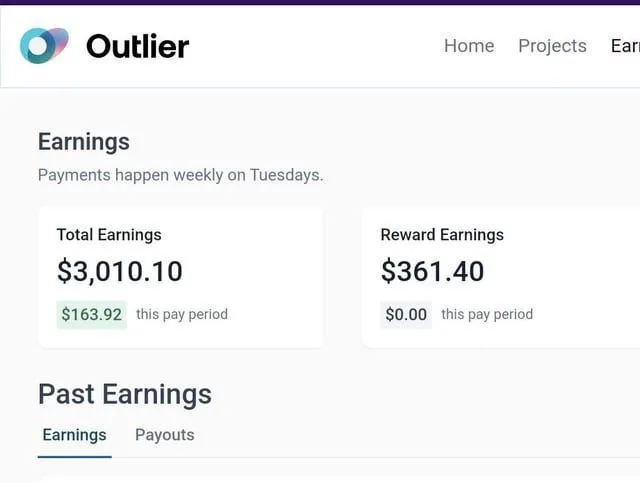
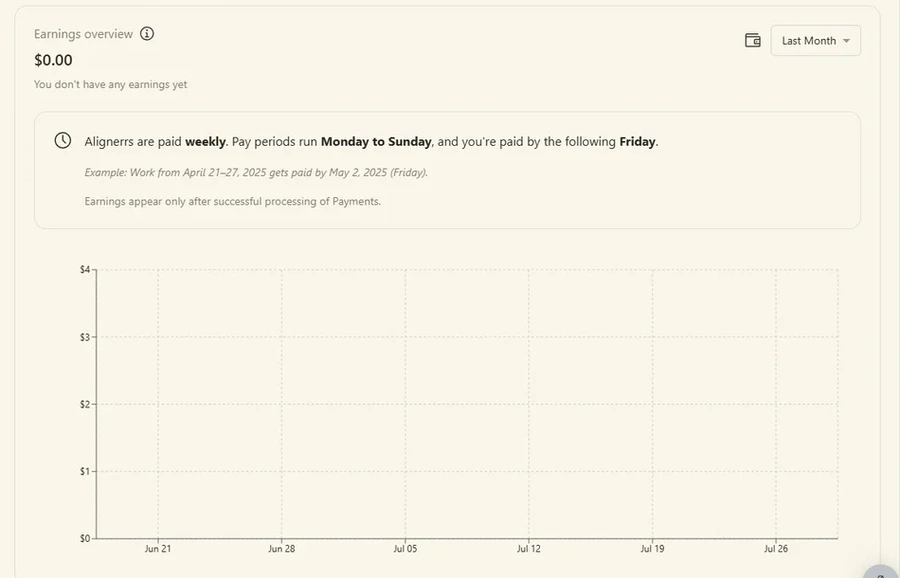
Neither of those is a scam and neither is a mistake on our side. That is just what the market does. Being accepted is not the same as being paid, and the distance between the two is measured in weeks. The detail on each account is in our Alignerr review and Outlier review.
Why the Income Is Seasonal
This is structural rather than bad luck. A lab needs a particular kind of data for a few weeks, funds a project, contributors ramp up, the target is hit, and the work stops. Contributors commonly describe a rhythm of short projects running a couple of weeks at a time, at somewhere between ten and twenty-five hours a week while they last, then a gap until the next one opens.
Three things make it harder to predict than an ordinary job:
- Projects end early. A client can close a project ahead of schedule and a chunk of your week disappears with little warning.
- Quality scores gate your access. Platforms score your work, and a dip can quietly stop the better projects being offered to you before anyone tells you why.
- Rates and rules change. Pay and eligibility move on the platform's schedule, so the rate you signed up on is not guaranteed to hold.
None of that makes AI training a bad use of your time. It makes the money real but lumpy, and lumpy income needs a different plan than steady income. If you want the mechanics of the empty queue itself, we covered those separately in accepted but no tasks.
What This Means for Your Money
The expensive mistake is quitting a stable job after two good AI months, then meeting the first dry spell with no cushion. The standard advice to keep three to six months of expenses is written for people with a predictable paycheck. For irregular income, planners generally push that higher.
Before you let this income carry your essentials
Treat three months of living expenses as the floor, not the target. Guidance for freelancers and other variable-income earners commonly lands at six to twelve months, and that is the range to aim for if AI training is going to be your main source rather than a top-up. The reasoning is simple: a fixed salary can be replaced with notice, while a project can end this Friday.
The second rule follows from the first. If one platform going quiet would put you behind on rent, that platform is not a side income, it is your whole income, and it is the riskiest possible version of one.
The Barbell: a Steady Base With AI on Top
People who earn from AI training over years rather than months almost never rely on it alone. They run a barbell.
The base
- One steady remote role that covers your essentials
- Predictable hours and a predictable payday
- Does not vanish when a project hits its target
- Usually the thing that makes building the buffer possible at all
The upside
- AI platforms worked hard when tasks are actually live
- Can beat your base hourly rate during a good wave
- A quiet week costs you a bonus, not the rent
- Keeps you close to how this work is changing
For an engineer this turns a gamble into a choice: hold a steady remote engineering role, and take short AI projects when the rate justifies the hours. Your stability stops depending on somebody else's funding calendar.
Does Stacking Platforms Fix It?
Partly, and it is worth doing. We have argued elsewhere that sustainable earners stack three or four platforms so the troughs never line up, and that still holds. It is the single best thing you can do to keep tasks in front of you.
But it is worth being precise about what stacking actually buys, because the two ideas get confused:
Stacking fixes availability. More platforms means fewer weeks where nothing at all is open to you. This is a real and significant improvement.
Stacking does not fix predictability. Four unpredictable incomes still add up to an unpredictable income. It raises the floor without ever telling you what next month looks like.
That gap is precisely what the steady base is for. Stack the platforms and hold the base. They solve different problems.
Are Some Platforms Steadier Than Others?
Yes, but less than you would hope, and not along the lines people expect. It is tempting to assume open task queues are steadier than project boards. That does not survive contact with the reports: DataAnnotation and Outlier both work as queues, yet DataAnnotation is widely reported as the steadier of the two while Outlier is the one contributors describe as having drought seasons. The dispatch model is not the deciding factor.
| What actually moves consistency | Why it matters |
|---|---|
| How many projects run at once | More concurrent projects means one ending is less likely to zero out your week |
| How broad your qualifications are | Clearing onboarding for several project types puts you in more queues at once |
| Your quality score | Higher-scoring contributors get offered work first when a wave opens |
| How specialised the work is | Niche expert work pays far more per hour but comes around less often |
The honest summary is that no platform is reliably consistent, and the ones paying the highest rates are often the least consistent, because specialist projects are rarer. Chasing the headline rate and chasing steady hours pull in opposite directions. The full field is in our roundup of AI training platforms that pay.
How to Build the Barbell on RemoWork
Both halves live in one place, which is the whole reason this site lists steady remote roles and AI training work side by side.
- Lock in the base first. The deepest live categories right now are engineering and development, sales and business development, operations and administration, product and project management and marketing and growth. Apply to several that would cover your essentials on their own.
- Stack the AI platforms on top. Three or four, so the troughs do not line up, and keep your quality scores clean on all of them.
- Bank the good weeks. Send the strong AI months to the buffer rather than into lifestyle. Three months of expenses is the floor, six or more if you ever intend to lean on this.
Related guides
- Accepted but no tasks? The mechanics of the empty queue, and how to shorten it.
- AI training platforms that pay in 2026. The full comparison.
- Alignerr review and Outlier review. The two accounts above, in detail.
- Mercor review. Longer engagements, harder to land.
Frequently Asked Questions
Can AI training replace a full-time job?
It can match full-time pay while a project is running, but the income is too lumpy to stand alone. Our own two accounts show the spread: $3,010.10 on one, $0.00 on the other over overlapping months, and the empty one had finished onboarding and held an invitation to a role advertising $60 to $120 an hour. Treat it as a supplement until you have a substantial buffer behind you.
Which AI training platform has the most consistent work?
None of them reliably. Among the big names, DataAnnotation is the one most often reported as steady, while Outlier is more often described as having drought stretches, even though both dispatch work as an open queue. Consistency tracks how many projects a platform runs at once, how many you have qualified for, and your quality score, far more than it tracks the brand. The highest-paying specialist work is usually the least frequent.
How much of a savings buffer should I keep?
Three months of living expenses is a floor rather than a goal. The usual advice of three to six months assumes a predictable paycheck, and guidance for freelancers and other variable-income earners commonly runs to six to twelve months. Aim for the higher end if AI training is going to be your main income rather than a top-up.
Does working several platforms solve the problem?
It solves half of it. Stacking three or four platforms genuinely reduces the number of weeks when nothing is available, and it is the best thing you can do on the platform side. It does not make your income predictable, because several unpredictable sources still add up to an unpredictable total. That is the half a steady base job covers.
Should I do AI training or look for a steady remote job?
Both, in that order. Lock in a steady remote role that covers your essentials, then add AI platforms for the high-paying weeks. The steady job takes the fear out of the dry spells, and the AI work adds real upside when projects are live.
Build Both Halves in One Place
Lock in a steady remote role for the base, then stack AI training work on top for the weeks that pay well.
Sources and How to Verify This
- Measured by us: the $3,010.10 and $0.00 figures, the $163.92 pay period and the Jun 21 to Jul 26 flat chart are read directly off our own Outlier and Alignerr dashboards, screenshotted above.
- Reported, not measured: project lengths, hours per week and the relative steadiness of DataAnnotation versus Outlier come from published first-hand accounts and contributor communities. A 30-day first-hand account of Outlier at Techpoint Africa describes "drought seasons" with no steady flow of assignments and advises against relying on it for a steady paycheck.
- Buffer guidance follows mainstream personal-finance advice for irregular income, where three to six months is the general baseline and six to twelve is commonly recommended for freelancers.
- Job counts cited for each category were read from the live RemoWork database in August 2026 and move as roles are posted and expire.