If you have earned money on Outlier, Mercor, Handshake AI, Alignerr or any other AI training platform, it belongs on your resume. It is legitimate contract experience showing skills employers are actively hiring for. The trick is framing it as professional contract work rather than a list of microtasks. This guide gives you the job titles, the entry structure, bullet points by task type, and a worked example we built in our own resume builder and scored twice.
The short answer: list AI training as one contract or freelance role, titled by what you actually did (AI Trainer, AI Data Annotator, AI Response Evaluator), name the platform, and write two to four bullets with real numbers in them. Treat it like any other remote contract job, because that is exactly what it is.
Every screenshot below comes from our own resume builder on a free account, so what you see is what you get without paying. The example candidate is fictional and the numbers in her bullets are illustrative placeholders, there to show the shape. Replace them with your own real figures, never copy them.
What to Call It: the Job Title
Pick a title that matches the work and reads clearly to a recruiter who has never heard of the platform.
- AI Trainer (Contract) for general response writing and evaluation work.
- AI Data Annotator for labeling text, image, audio or video data.
- AI Response Evaluator for rating and ranking model outputs.
- Freelance AI Trainer, [Your Domain] if you worked a specialty such as coding, medicine, law or a language.
Avoid vague titles like "Remote Worker" and platform-only labels like "Outlier Contributor". A recruiter should understand the role from the title alone, without knowing the brand.
How to Structure the Entry
Format it exactly like a normal job: title, platform, location, dates. Here is that shape as our builder renders it, using the classic Harvard template.
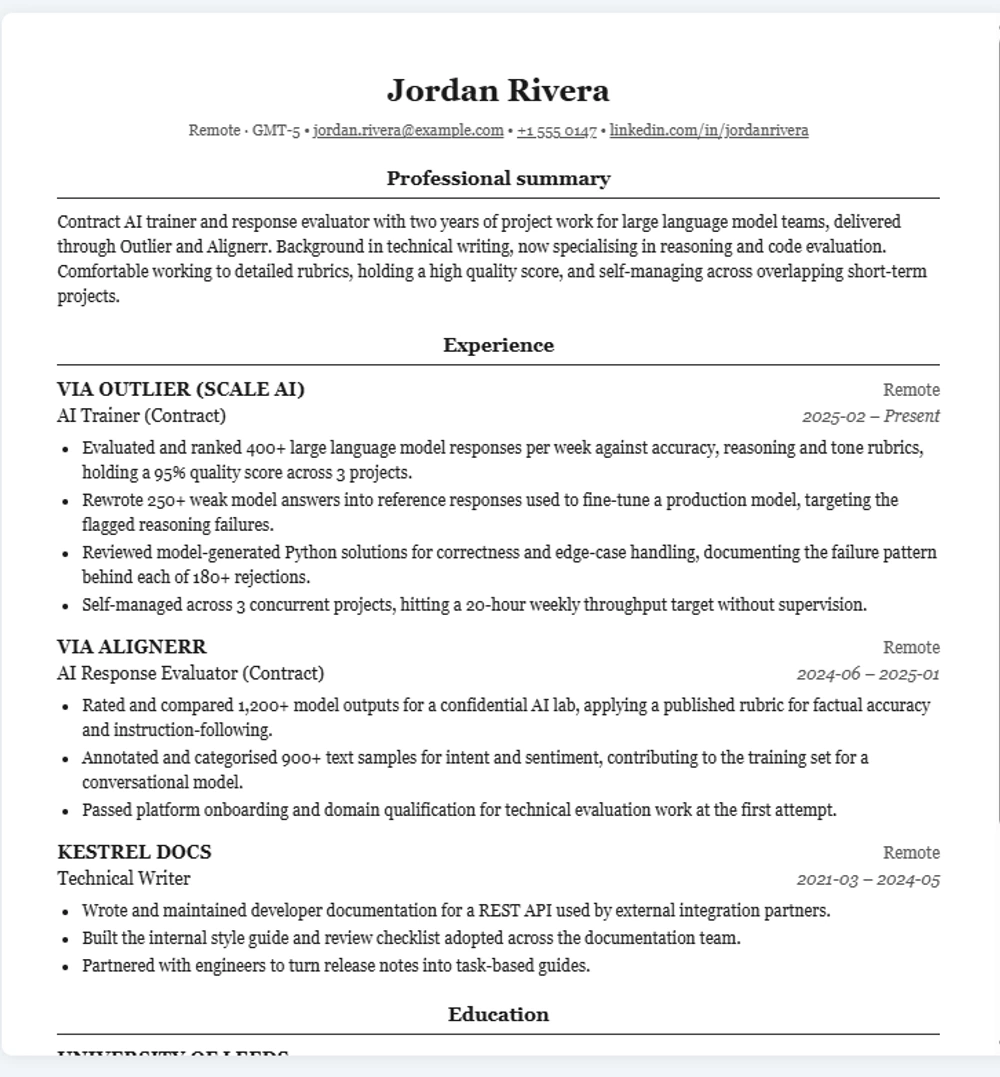
Two details worth copying. The role is labelled (Contract), which is accurate and costs you nothing. And the platform is written as "via Outlier (Scale AI)", which tells a recruiter both the brand they might recognise and the one they might not.
The Part Everyone Gets Wrong: Numbers
This is the single biggest difference between an AI training entry that works and one that gets skipped, and we can show it rather than claim it. We built the example resume above in our own builder and let the tool score it before touching the bullets. The bullets described the work accurately but contained no figures.
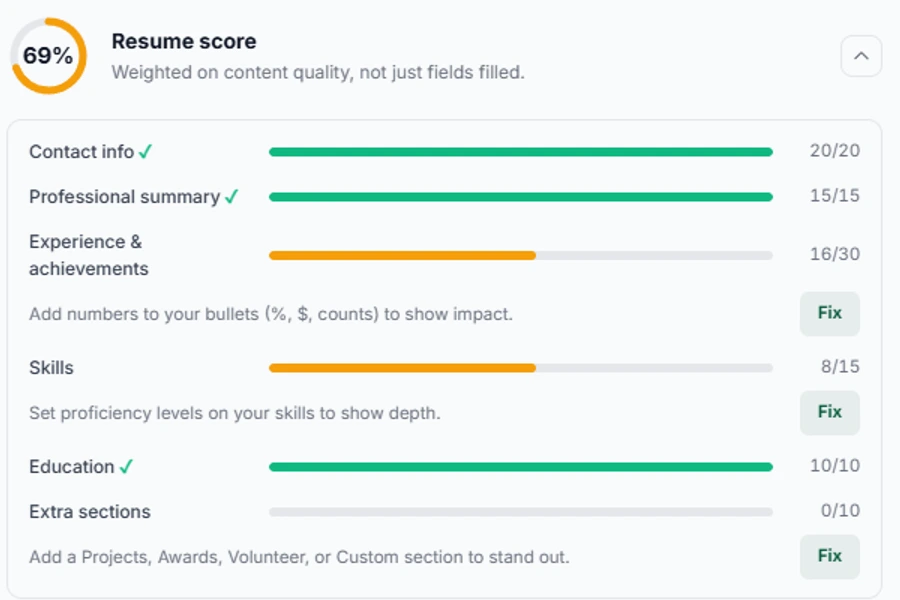
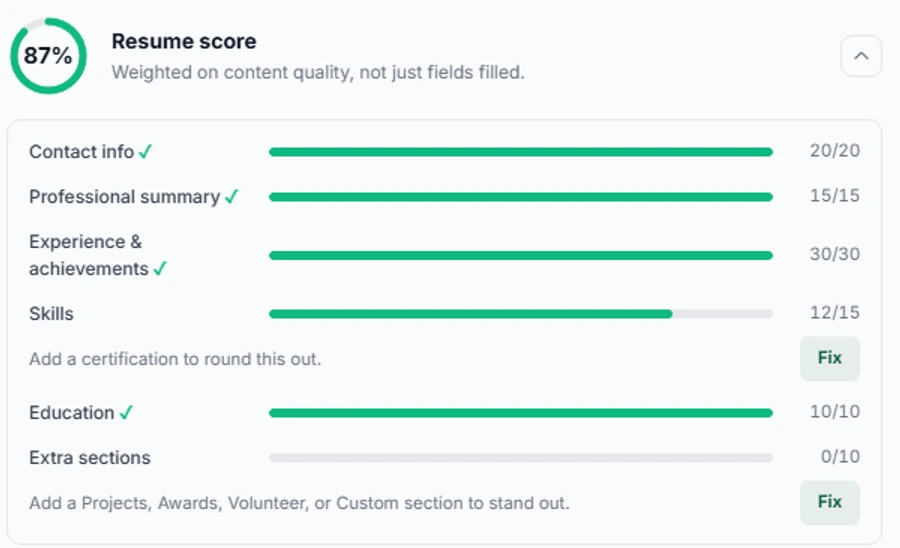
So we did only that. Same roles, same platforms, same work, with counts and a quality score added to each bullet, plus proficiency levels on the skills. Nothing invented about the nature of the work, just the specifics filled in.
Use your own numbers, not ours
The figures in the example are placeholders chosen to show the shape of a strong bullet. Do not copy them. If you do not know your exact task count, use an honest range or the quality tier the platform actually showed you. An invented metric is the easiest thing in the world for an interviewer to unpick, and our own resume AI is built to refuse to write them for you.
Example Bullet Points by Task Type
Pick the ones matching what you did and swap in your own figures.
Writing and evaluation
- Reviewed and rated [N] AI-generated responses per week for factual accuracy and coherence, holding a [X] quality rating.
- Rewrote weak model answers into reference responses used to fine-tune a large language model.
Coding and STEM
- Created and validated Python tasks with test cases used to train models on real programming problems.
- Reviewed model-generated solutions for correctness and edge cases, documenting the reasoning error behind each rejection.
Data annotation
- Annotated [N] images and audio clips for object detection and transcription at [X] accuracy against a project rubric.
- Labeled and categorised text data for sentiment and intent, contributing to a conversational AI training set.
Domain expert
- Provided expert medical review of AI responses, correcting clinical inaccuracies a non-specialist would miss.
- Acted as a native-language reviewer, evaluating translation quality and cultural nuance for a multilingual project.
The Skills to Pull Out
AI training teaches skills employers search for by name. Add the ones you can actually evidence: prompt engineering, reinforcement learning from human feedback (RLHF), data annotation and labeling, model evaluation, rubric-based quality assurance, your domain expertise, and remote self-management. They read well to AI companies and to ordinary employers who want people comfortable working alongside AI.
Setting a proficiency level on each one was worth 4 further points in the score above, and it stops a long skills list reading as a keyword dump.
Naming the Platform vs the AI Lab
Name the platform you worked through, since that is verifiable. You often will not know, or will not be permitted to name, the end client, and plenty of projects sit under a non-disclosure agreement. When that is the case write "confidential AI lab via [platform]" rather than guessing. Never invent a client name, it is trivially checkable and it is the kind of thing that ends an application.
Common Mistakes to Avoid
- Listing every platform separately. Group the work into one entry, or two at most, not a stack of ten microtask sites.
- Claiming you were an employee. This is contract work. Label it that way; overstating it is easy to catch.
- No numbers. "Did AI tasks" says nothing. That is the 16/30 above.
- Overselling seniority. Recruiters value the real skills more than an inflated title.
- Hiding it. Short, waved-off gigs still show evaluation skill, judgement and the ability to self-manage to a standard.
Building It in the Resume Builder
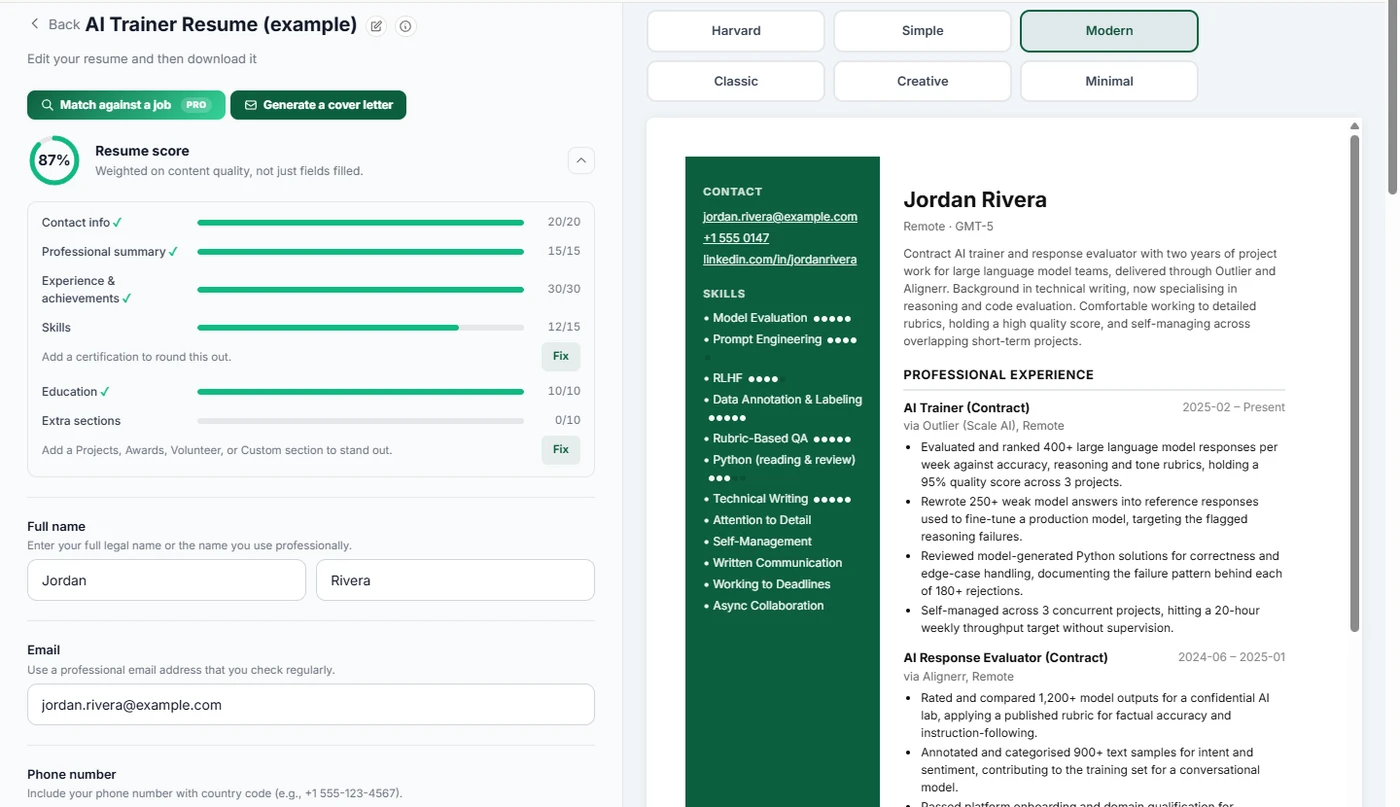
Everything above happened in the editor below. The form is on the left with the live score, the six templates and the preview are on the right, and the whole thing updates as you type.
Free, no catch
- All six templates and the live preview
- The scoring panel and its fix-it guidance
- PDF and DOCX download
- A shareable public link
- The ATS resume checker and a first free job match
Needs Pro
- AI bullet coach and whole-role rewriting
- Tailoring a resume to a specific job
- Repeat job-description matching
- Summary studio variants
- Removing the footer line from exports
The before and after above used none of the Pro features. The score panel is free, and it was enough to find the problem and confirm the fix.
Related guides
- How to get accepted on AI training platforms. Getting in, before you have anything to list.
- AI training platforms that pay in 2026. Where the work is.
- Why AI training income is seasonal. Why you want a steady role alongside it.
- Writing a standout remote resume. The rest of the document.
Frequently Asked Questions
Should I put Outlier or Handshake AI on my resume?
Yes. Contributing to AI training and evaluation is legitimate freelance experience demonstrating real skills. List it as a contract AI trainer or evaluator role, name the platform, and describe what you delivered. It is especially relevant when applying to other AI or tech roles.
What job title should I use for AI training work?
Use a title describing the work: AI Trainer, AI Data Annotator or AI Response Evaluator. If you worked a specialty, add the domain, for example "Freelance AI Trainer, Coding". Avoid platform-only labels like "Outlier Contributor" that a recruiter will not understand.
Does AI training count as real work experience?
Yes. It demonstrates evaluation, annotation, domain judgement, attention to detail, and the ability to self-manage remote contract work to a quality standard. Those transfer, and they matter more each year as ordinary roles start involving work alongside AI.
Can I include AI training if I only did it for a few weeks?
Yes, framed honestly. Because the work arrives in waves, short stints are normal rather than a red flag. Group them into one contract entry with a date range, and focus the bullets on what you delivered rather than hours logged.
Should I name the AI company or the platform?
Name the platform, since it is verifiable. You usually will not know or be permitted to name the end client, and some work sits under a non-disclosure agreement. In that case write "confidential AI lab via [platform]" instead of guessing at a client name.
What if I do not remember my exact numbers?
Use an honest range, or the quality tier the platform actually showed you, or the length and count of the projects you worked. "Reviewed several hundred responses per week across three projects" beats a precise number you cannot stand behind in an interview. Do not invent a figure to fill the gap.
Build the Entry You Just Read About
Six templates, a live score that tells you what is weak, and PDF download. Free, and it takes a few minutes.