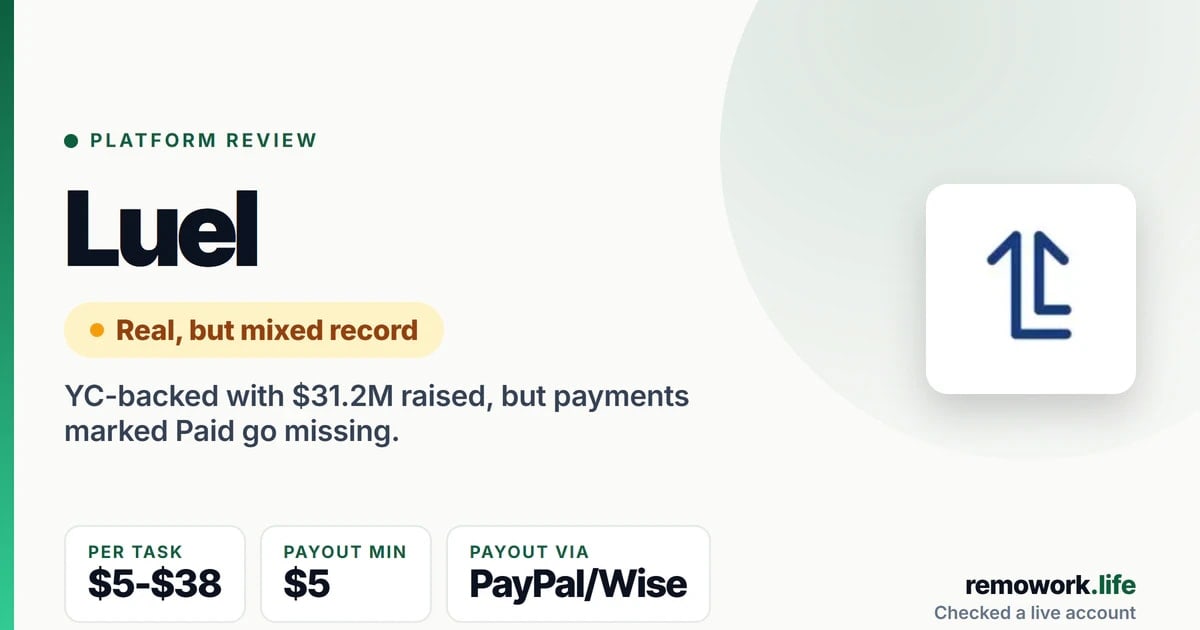
Luel raised $31.2 million before most companies have a working product, one of the largest seed rounds in Y Combinator's history. It pays real people for video, audio, and even CAD design recordings that train the next wave of AI models. Here is what Luel actually is, what it pays, and whether the complaints about it are something to worry about.
The quick answer: Luel is real and well-funded, a Y Combinator W2026 company backed by Lightspeed and General Catalyst with 500,000+ contributors across 96 countries. Pay runs from about $5 per approved task to $38/hr depending on the work, paid out via PayPal, Wise, or Stripe with a $5 minimum payout. The catch: a genuine, repeated complaint pattern around inconsistent rejections and payments that show as "Paid" without arriving, serious enough to know about before you invest real time.
Pay figures below are quoted from Luel's own contribute page and cross-checked against a live contributor dashboard, not screenshots or press coverage alone. Task availability and rates change, so confirm on the live board before applying.
What is Luel?
Luel is a rights-cleared, multimodal training-data marketplace, not an audio-only platform. Contributors supply video, audio, screen recordings, CAD design sessions, and images, which Luel verifies and licenses to frontier AI labs building "the foundations of machine perception." Founded in late 2025 in San Francisco by teenage founders William Namgyal (CEO, previously a founding engineer at Relixir and co-founder of computer-vision startup ezML) and Inigo Lenderking (COO), Luel went through Y Combinator's W2026 batch and raised $31.2 million in seed funding from Lightspeed and General Catalyst, with Paul Graham and executives from Microsoft, xAI, Apple, and Meta's board also participating. The company reports reaching $2 million in annual recurring revenue within six weeks of demo day, and a contributor network of over 500,000 people across 96 countries. Its own funding announcement adds specifics worth knowing: Luel can spin up a new dataset campaign in under 24 hours, serves customers spanning generative AI labs, robotics companies, social platforms, universities, hospitals, and banks, and turned down three acquisition offers while raising this round.
How much does Luel pay?
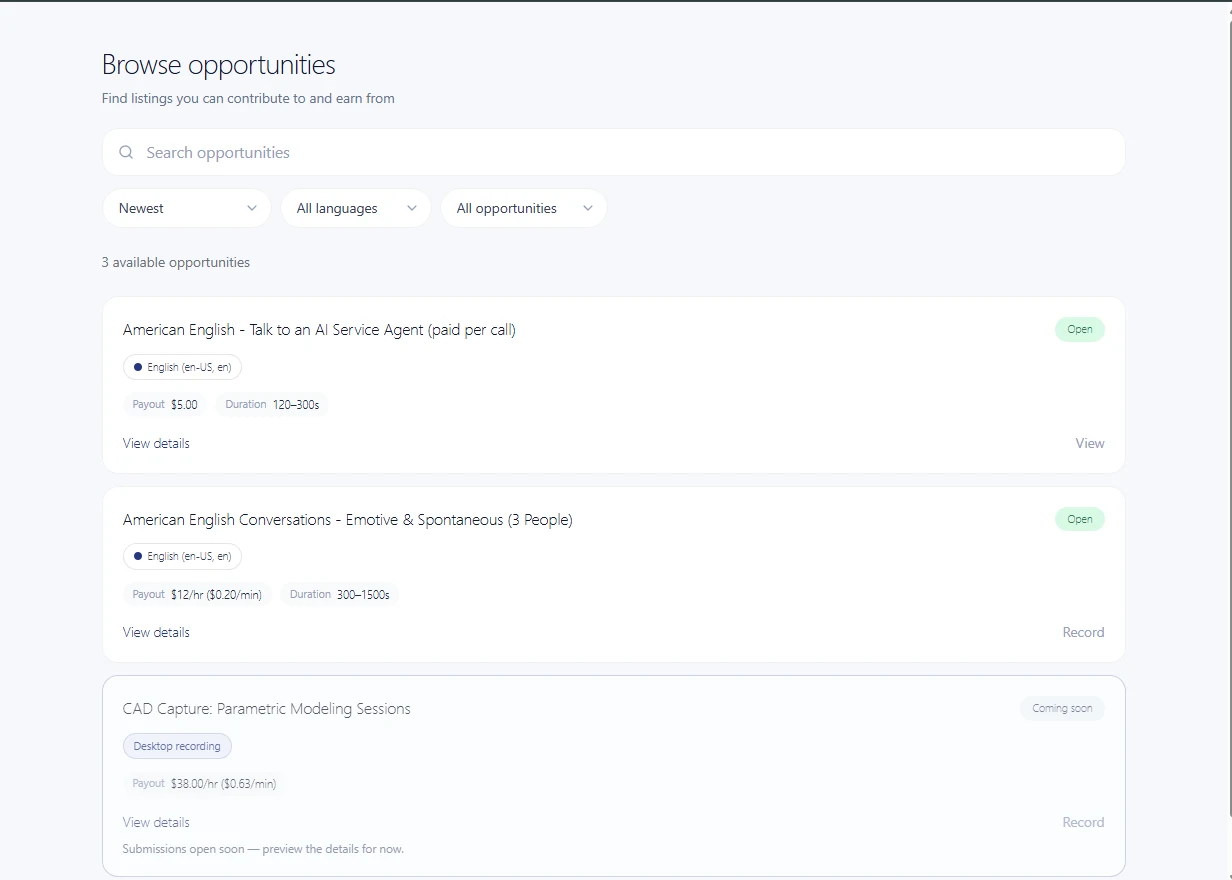
Rates are published per task type on Luel's own contribute page, and they vary more than most platforms because the work itself spans several formats. What is actually open changes, though: checked against a live contributor account, only three tasks were available at the time of writing.
| Task type | Rate | Availability |
|---|---|---|
| AI service-agent phone calls | $5 per approved conversation (1-5 min) | Open |
| Group conversations (3 people) | $12/hr ($0.20/min) per person | Open |
| CAD modeling sessions | $38/hr ($0.63/min) | Coming soon, not yet accepting submissions |
| Rare-language audio (Kabyle, Balochi, Guarani, others) | $7.50/hr ($0.13/min) per participant | Published rate, not on the live board at time of writing |
That gap matters: Luel's rate card reads like a menu, but the actual number of open tasks on any given day is small, a live account showed just three opportunities total, one of them not yet accepting submissions. Independent, third-party estimates put general approved video and voice clips at around $0.50 a minute, which works out to roughly $60 to $120 a month for someone submitting 30 to 60 minutes of approved material weekly, with a realistic ceiling closer to $300 to $500 a month for a serious part-time contributor. Treat these as attributed estimates rather than a guarantee, actual earnings depend on how much of your submitted work gets approved and how many tasks are open when you check. Submissions must sound genuinely unscripted, Luel explicitly rejects "reading from a script or sounding staged," recordings under a minute, and background noise. At least one task type is restricted to US and Canada native English speakers, but that reads as a per-task rule rather than a platform-wide one given the 96-country contributor base.
Payouts go out via PayPal, Wise, or Stripe, each set up as a payment method on your contributor dashboard, with a $5.00 minimum before you can request a payout. Luel's own dashboard states payouts are processed daily; treat "processed" and "money in your account" as two different moments, and confirm your first payout lands before relying on the schedule.
The revenue-share angle
This is the one detail that sets Luel apart from every other platform in this series. Most platforms pay once for an approved task and keep all further value from reselling that data. Luel instead pays contributors a revenue share when their clips are re-licensed after an exclusive licensing window expires. If your recording keeps getting used, you keep getting paid for it, at least in principle. It is a genuinely different incentive structure worth knowing about, even if it will not change your first month's earnings.
Is Luel legit? The complaint pattern
Luel is a real company. A $31.2 million seed round from named investors like Lightspeed and General Catalyst is not something fraud operators attract, there is too much scrutiny and too much to lose. But "well-funded" and "friction-free" are not the same thing, and Luel's Trustpilot reviews are genuinely mixed: five-star "best side hustle" praise sitting next to one-star complaints. Three patterns show up repeatedly across independent sources:
- Inconsistent rejections. Submissions declined for reasons like "script mismatch" despite the contributor following the prompt, with near-identical clips reportedly receiving different verdicts and no reviewer feedback explaining why.
- Payment reliability. Multiple reports describe a dashboard showing a submission as "Paid" while the money never actually arrived, alongside reports of partial payments.
- Account and Discord bans after complaints. Several contributors report being removed from Luel's support Discord or having their account suspended after raising a payment issue.
Worth keeping in perspective: Luel reports 500,000-plus contributors, so even a small percentage complaint rate produces a large number of loud, visible complaints. That context does not excuse the pattern, but it does explain why it is so visible online. The honest read is the same one we have given other well-funded but young platforms in this series: this is not a scam, but it is not friction-free either. Start small, confirm a few submissions actually get approved and actually get paid, before investing real hours.
What the work is actually like
Everything runs through Luel's phone and web app. Task briefings specify what is needed, sometimes down to location and language, and the app captures device metadata and timestamps alongside your recording. Consent is captured per submission rather than once at signup. Signing up itself is a short, three-step profile flow that asks which recording devices you own, from a smartphone to a DSLR to smart glasses, to match you to suitable tasks. Contributors who maintain a high acceptance rate reportedly get priority access to new tasks, which matters given that task scarcity, waiting days between assignments, is itself a documented complaint, and matches what a live account showed: a short, rotating list of open opportunities rather than a constant stream of work.
How it compares
Within our own roundup of voice and audio AI training platforms, Luel sits alongside Babel Audio and Pila8 as one of the lower-friction ways to start, everything happens through a phone app rather than a dedicated recording setup. The closest comparison for the "niche language" angle specifically is Welo Data, which also recruits speakers of less-common languages, though Welo Data does not publish a fixed rate card the way Luel does. Luel's real edge is speed and format variety, phone-first tasks across audio, video, and even CAD work, plus the revenue-share mechanic nothing else here offers. Its real weakness is the moderation and payment consistency issues documented above, which are more frequently reported than on some of its more established peers.
Is it worth it?
Worth trying, with a deliberately cautious first step. The company is real, the funding is real, and the pay rates are published and specific rather than vague. But given the documented rejection and payment-reliability complaints, and given how few tasks are actually open on any given day, treat your first few submissions as a test: confirm they get approved and the money actually lands before committing serious hours. See how it stacks up against every other platform in this space in our roundup of AI training platforms that pay.
Frequently Asked Questions
Is Luel legit?
Yes. Luel is a Y Combinator W2026 company that raised $31.2 million from Lightspeed and General Catalyst, with over 500,000 contributors across 96 countries. It is not a scam, but it does have a real, documented pattern of inconsistent rejections and payment-reliability complaints worth knowing about before you invest significant time.
How much does Luel pay?
Rates vary by task: $5 per approved AI-agent phone call, $12/hr per person for group conversations, and $38/hr for CAD modeling sessions (not yet accepting submissions at time of writing). Independent estimates put general video and voice work around $0.50/minute, roughly $60-$120/month part-time up to $300-$500/month for a serious contributor. Only a handful of tasks are open on any given day.
Does Luel actually pay contributors?
Mostly, but not always reliably. Luel's dashboard states payouts are processed daily via PayPal, Wise, or Stripe, with a $5 minimum payout. However, multiple contributors report submissions marked "Paid" that never arrived, so confirm your first few payouts before relying on the platform for steady income.
What kind of work does Luel need?
Natural, unscripted conversations, simulated phone calls with AI agents, CAD design recordings, rare-language audio, and scripts or monologues. Everything runs through Luel's phone or web app, and submissions must sound genuinely unscripted, staged-sounding or under-a-minute recordings are rejected.
How is Luel different from other AI training platforms?
Two things: it is multimodal rather than audio-only, covering video, CAD sessions, and sensor data alongside voice, and it pays a revenue share when your submitted clips are re-licensed after their exclusive window expires. No other platform in our roundup offers that second part.
Ready to Start Earning by Training AI?
Browse verified, remote AI training and data roles on RemoWork, and compare Luel against every other platform paying real money right now.
Explore AI Training Jobs