Handshake AI and Outlier are the two platforms people compare most when they want to get paid for training AI, and the question is always the same: which one pays more, and which should I actually join? We hold real accounts on both, so this comparison runs on our own payout screens rather than the ranges everyone copies from each other. The short version is that the honest answer has less to do with the rate than with whether you can get in at all.
The quick answer: Handshake AI has the higher ceiling, with verified rates up to $125 an hour, but it gatekeeps hard on US work authorization and credentials. Outlier is open in 117 countries and territories and far easier to join, but its rate is set by your country and language, from about $8 an hour up to $35 for a US specialist role. So the deciding factor is not the headline number, it is your situation. Outside the US, Outlier is usually the only one of the two actually open to you, as long as your country is on its list, which does not include Kenya, Nigeria or Ghana.
Every figure below is checked against our own two platform reviews and our own accounts. Where a screenshot came from another contributor rather than us, the caption says so. We hold no referral relationship with either platform, so nothing here is steering you toward a commission.
Handshake AI vs Outlier at a glance
Both pay you to improve AI models by evaluating outputs, writing better responses and labelling data. Here is how they line up on the things that actually decide it.
| Handshake AI | Outlier | |
|---|---|---|
| Operator | Handshake AI Solutions LLC | Scale AI |
| Verified pay | $17 to $125/hr by project | $8 to $100/hr, set by country and language |
| Who can join | US work authorization plus credentials | 117 countries and territories, straightforward sign-up |
| Work type | Expert evaluation and training, via Multimango | Labelling, evaluation, coding and language work |
| Payment | Weekly through Deel, then you withdraw | Weekly on Tuesdays, PayPal, ACH or Airtm |
| Work availability | Project-based, waves and pauses, task limits | Waves, unpredictable, slow support |
| Best for | US-based specialists chasing the top rate | Anyone worldwide who needs an open door |
Which one pays more?
Handshake AI wins on the ceiling, and it is not close. Its specialist projects genuinely list $125 an hour, and we have seen those rates on live dashboards rather than in marketing copy.
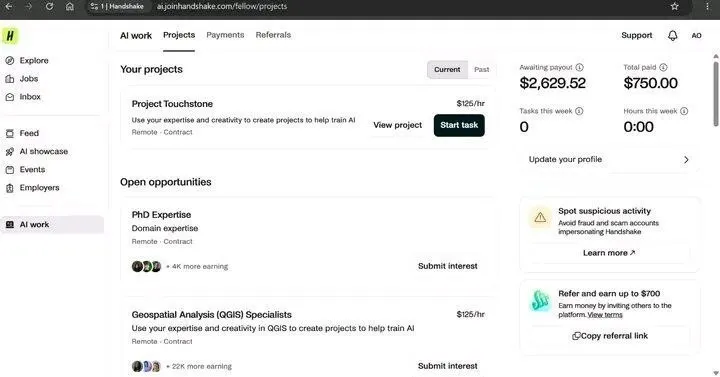
The catch is that $125 an hour is the top of a wide ladder, and most people do not start there. Verified Handshake rates run from about $17 an hour for generalist evaluation work up to $125 for expert and design-heavy projects, with plenty in between at $30 and $50. You need the credential that opens the specialist track before the headline number means anything to you.
Outlier is advertised at $8 to $100 an hour, but that range hides the thing that actually determines your pay: your country and your language. The same board, on the same day, offers wildly different money depending on which market you are in.
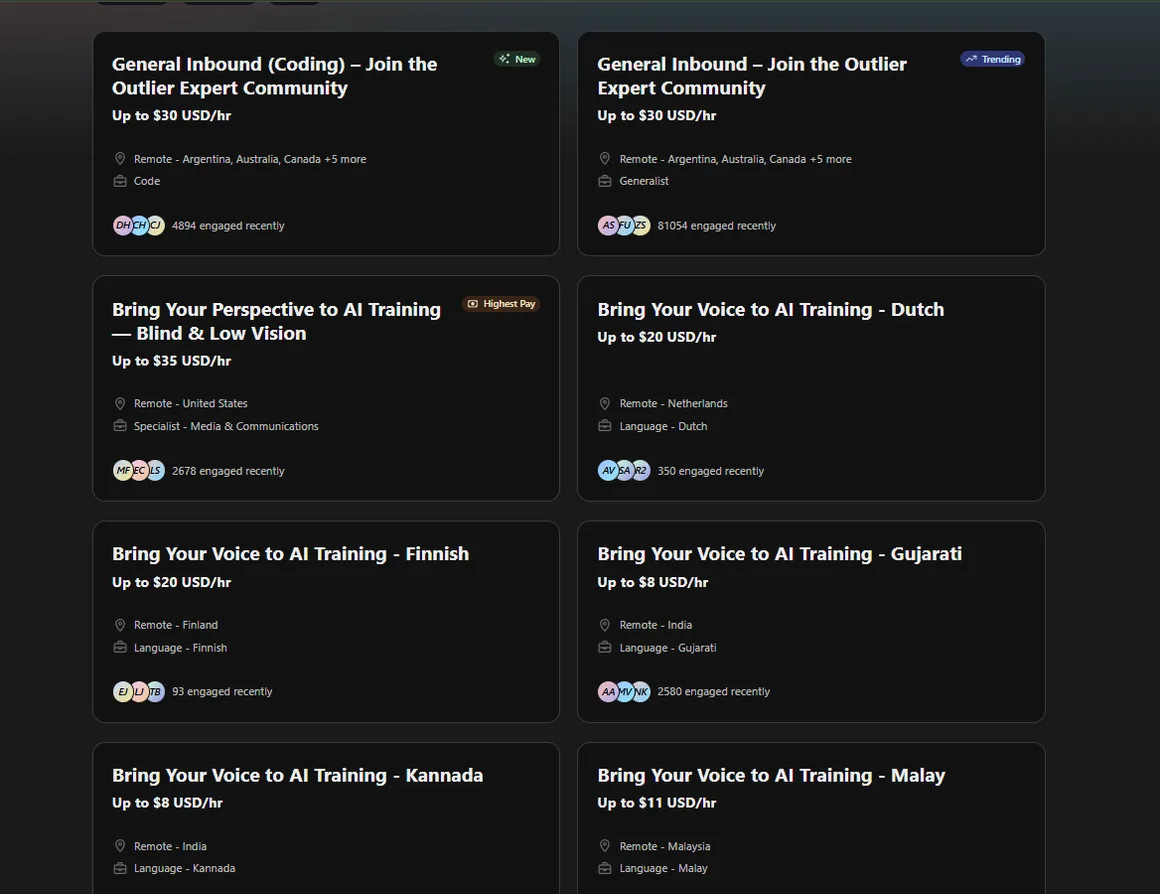
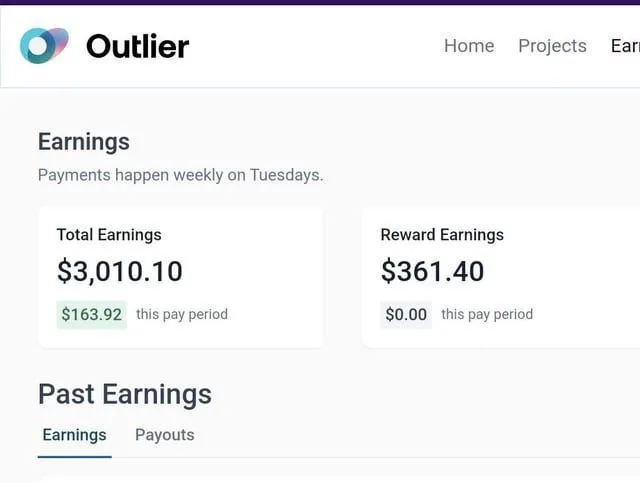
Read that board again, because it answers the question better than any table. Outlier's "highest pay" badge sat on a United States specialist role at $35 an hour, while language work based in India was offered at $8. Same platform, same week, a four-fold difference driven by geography rather than skill. Our own generalist project paid $15 an hour, and our lifetime earnings on the account sit just over $3,000.
The comparison most articles get wrong
Comparing "up to $125" against "up to $100" is close to meaningless, because almost nobody earns either. The comparison that matters to most readers is the realistic middle: roughly $17 to $40 an hour on Handshake for generalist work, against roughly $8 to $30 on Outlier depending on where you live. And if Handshake is closed to you, its ceiling is irrelevant at any number.
Which one is easier to join?
This is where the two split hardest, and for most readers it settles the whole comparison. Outlier is open to contributors in the 117 countries and territories on its working-location policy, which covers India and the Philippines but not Kenya, Nigeria or Ghana. You register, complete an assessment for a project, and start once you qualify. It remains one of the most accessible routes into AI training work if you live outside the high-income markets.
Handshake AI is built around the US academic and professional system. It expects valid US work authorization and leans on credentials such as a degree, graduate study or senior professional experience, with identity checked against university records. Some student visa categories can qualify, others are explicitly excluded. For applicants in countries like India, Nigeria, the Philippines or Kenya, access is effectively unavailable, which is why so many people end up on Outlier by default. That default has gaps too: Outlier's working-location policy lists India and the Philippines but not Nigeria or Kenya. Our first-hand Handshake AI review covers the eligibility bar in detail.
What the work is actually like
On Handshake AI the work skews toward expert judgment: reviewing model answers in your field, writing high-quality reference responses and flagging where the model reasons badly. Tasks are delivered through the Multimango workspace, and because they are tied to named specialist projects, it feels closer to contract consulting than to gig microtasks. When a project is live the money is genuinely strong. When it pauses, it goes quiet.
On Outlier the work is broader and more variable, from coding and writing evaluation to data labelling and preference ranking. It is a reasonable place to learn the ropes because there is usually something to qualify for, but project quality varies and instructions can change mid-task. Our Outlier review walks through a real account and the day-to-day.
How each one actually pays you
This trips people up, because the two work differently and a lot of comparisons state it wrongly. Handshake AI does not pay you directly through PayPal. It pays weekly through Deel, under the entity Handshake AI Solutions LLC, into a Handshake balance. From there you withdraw to your own method.

Outlier pays weekly on Tuesdays, straight out to PayPal, ACH or Airtm depending on your region. That makes Outlier the simpler of the two to get money out of, especially outside the US, since it does not put a third-party payroll platform in the middle. For a fuller picture of the payout rails these platforms use, see our guide to how AI training platforms actually pay you.
The honest caveats on both
Neither of these is a salary. On Handshake AI, work arrives in waves, projects pause without much warning, and there are per-contributor task limits that cap how much you can take even when a project is busy. The platform is also explicit that a listed rate is an estimate rather than a guarantee, and some contributors have reported pay-rate changes on 2026 projects. We have not independently verified those disputes, so treat them as reported rather than established.
On Outlier, the recurring complaints are the same two every time: work comes in unpredictable waves, and support is slow, with template responses when something goes wrong. Add the geography-indexed pay above and the honest framing is that either platform is variable income you top up with other work, not a paycheck you can plan a month around.
One safety note that applies to Handshake in particular: because the brand is well known, phishing sites impersonate it. Apply only through the official fellow portal, and treat any other domain asking for your details as hostile.
Which should you choose?
Choose Outlier if you are outside the US, have no formal credentials, or just want the fastest realistic way into AI training work. For most people worldwide it is the only one of the two that is genuinely open. Check the rate on the specific project card before you commit hours, because your market sets it.
Choose Handshake AI if you have US work authorization plus a degree, graduate study or senior professional experience. Its specialist rates are the highest of the two by a wide margin, and the work respects the expertise you already have.
Run both if you qualify for each. They do not conflict, and because work arrives in waves on both, two sources smooth out the quiet weeks. Many steady earners add a third, most often Mercor.
The verdict: Handshake AI wins on pay, Outlier wins on access, and access is the one you cannot negotiate. If both are open to you, Handshake is the better paycheck. If only one is, that one is your answer, and the comparison was never really about the rate.
Related guides
- Handshake AI review. Pay, legitimacy, eligibility and how it works.
- Outlier review. Getting started, tasks and pay from a real account.
- Every AI training platform that pays. The full comparison hub.
- Handshake on RemoWork and Outlier on RemoWork. Company profiles and live roles.
Frequently Asked Questions
Which pays more, Handshake AI or Outlier?
Handshake AI pays more at the top. Its verified rates run from about $17 an hour for generalist evaluation up to $125 an hour for specialist projects. Outlier ranges from about $8 to $100 an hour, but what you are offered depends heavily on your country and language: we saw $35 an hour for a US specialist role and $8 an hour for Indian language work on the same board. For most people the realistic comparison is $17 to $40 on Handshake against $8 to $30 on Outlier.
Can I work on both Handshake AI and Outlier at the same time?
Yes. Both are independent contractor platforms with no exclusivity, so you can hold accounts on both. Because work on each arrives in unpredictable waves, running both is a common way to keep your hours filled and your income steadier.
Is Handshake AI available outside the US?
Mostly no. Handshake AI is built around the US academic system and expects valid US work authorization, with identity verified against university records. Some student visa categories can qualify and others are excluded. For applicants in countries such as India, Nigeria, the Philippines or Kenya, access is effectively unavailable. Outlier is the realistic option in India and the Philippines, which are on its 117-place working-location list; Nigeria and Kenya are not, so applicants there need other platforms.
Is Outlier or Handshake AI better for beginners?
Outlier is easier for beginners because sign-up is open in 117 countries and territories and generalist projects do not require credentials. Handshake AI suits people who already hold a degree, graduate study or senior professional experience, since its best-paying work is credential-gated and US-restricted.
Is Handshake AI more legit than Outlier?
Both are legitimate and both pay real money, and neither charges you to join. Outlier is run by Scale AI, and Handshake AI pays through Deel under the registered entity Handshake AI Solutions LLC. The risks are about consistency rather than fraud: variable work volume on both, task limits and reported pay-rate changes on some Handshake projects, and slow support on Outlier. Be aware that phishing sites impersonate the Handshake brand, so use only the official portal.
Skip the Waiting List
Both platforms run hot and cold. Browse verified remote AI training and data roles on RemoWork while you wait for your next project to open.