Senior Electrical & Electronic Engineering Expert – AI Research & Evaluation Engagement Type: Contract / Independent Contractor Availability Required: 35 hours per week Experience: 8+ years Qualification: PhD / MS / MEng in Electrical Engineering, Electronic Engineering, or…
PSoC 6 AI Kit (CY8CKIT-062S2-AI): C firmware with ModusToolbox
Remote (Global)
$150 per successful submission
November 27, 2026
Job description
Pay: $150 / successful submission
Write a firmware task for Infineon's PSoC 6 AI Kit: a real job an embedded engineer gets, like a field bug, a power or timing problem, or a new requirement on a working project. An AI model tries to solve it, and its firmware is graded on a real kit on our bench, not in a simulator.
How it works
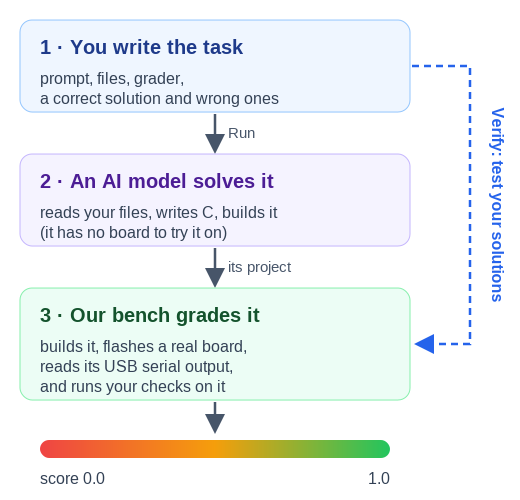
- Build and Verify. Verify runs your correct and wrong solutions on the real board, so you see how the hardware treats them. You don't need a board of your own.
- Run. This hands the task in. The AI models attempt it, and each attempt is graded on the bench.
- Review. When all runs finish, we review the task. If the models solve it easily, it isn't a good task: depending on the task, we send it back with feedback or close it.
The hardware
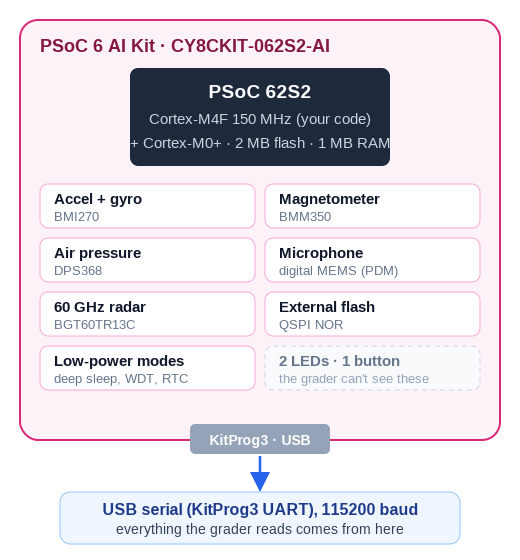
Your firmware runs on the Cortex-M4F; the Cortex-M0+ runs Infineon's ready-made image. The kit has an accelerometer and gyro, a magnetometer, a pressure sensor, a microphone, a 60 GHz radar and external flash, plus the chip's low-power modes. It is powered over USB and its flash is erased before every flash and after every grade.
For now, the grader reads only the USB serial port. The firmware can still use any peripheral on the board. It just prints its results there.
The environment
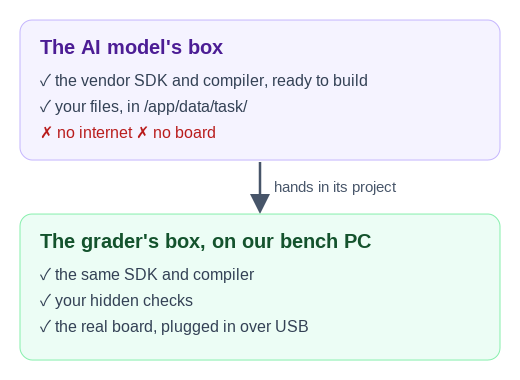
The model has Infineon's ModusToolbox libraries for this kit (board support, PDL, HAL, FreeRTOS) and the Arm GCC compiler. It can build as often as it likes but can't run anything, like an engineer with a build machine and a bug report. Put your files under data/task/ in the environment.
The box has no drivers for the kit's sensors. If your task uses one, ship its driver or the register notes the model needs with your files.
Writing a good task
It must end in firmware. The answer is code that is built, flashed onto the board and graded by what it prints. A task whose answer is an explanation or a number doesn't fit.
Aim for the right side. The model should have to work something out from the evidence you give it (a datasheet, a bench log, a bug report). If the first fix that comes to mind passes, the task is too easy.
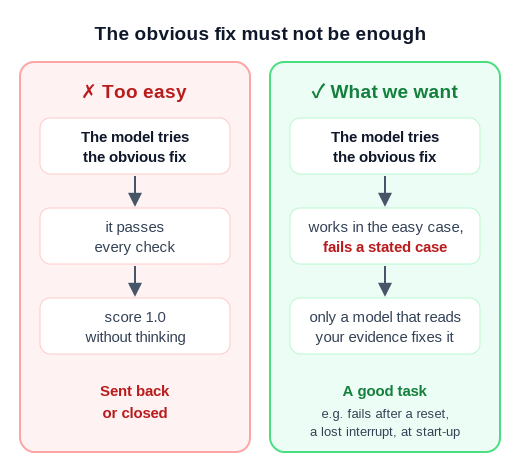
Use the real hardware. The best tasks depend on how the board really behaves. Ideas: a low-power mode that drifts the clock or loses a wake-up, a watchdog that behaves differently in deep sleep, a sensor that needs a specific start-up order, motion or pressure data that must be filtered and timed, audio from the microphone.
Give every requirement, never the fix. Each thing the grader checks is written in the model's files, with numbers and units. Nothing the model sees spells out the solution.
Make the grade reliable. Real boards have noise and jitter. Check ranges, not exact values, leave margin on time limits, and make sure your correct solution passes on every Verify run. Measure board facts (start-up times, readings at rest) on the bench through Verify before you rely on them.
References: one correct solution, and at most three wrong ones that a competent engineer could plausibly write first.
Explain it to us in references/steps.md, which the model never sees: the idea in one sentence, the trap, which checks catch it, and anything you measured on the bench.
Make it your own. You must have the right to share every file you use, including for AI training, and you confirm at hand-in that you made the task yourself, without AI generating it.
No AI-generated tasks (real work only)
Brief details: Optimised run · Pre-created environment · Several submissions allowed
Who can apply
- Open to
- Anywhere in the world
- Posted
- November 27, 2026 by Hashlist
- Last checked
- November 29, 2026: still open on dop.hashlist.com, where you apply
Apply now
Opens dop.hashlist.com in a new tab. If they ask how you found the role, mention RemoWork.
Write a firmware task for the Silicon Labs xG24 Dev Kit: a real job an embedded engineer gets, like a field bug, a sensor that misbehaves, or a new requirement on a working project.
Write a firmware task for ST's NUCLEO-H503RB: a real job an embedded engineer gets, like a field bug, a change of clock or timing, or a new requirement on a working project.
Write an Arduino sketch task for the Arduino UNO Q: a real job an embedded engineer gets, like a field bug, a timing problem, or a new requirement on a working sketch. An AI model tries to solve it, and its sketch is graded on a real UNO Q on our bench, not in a simulator.